
Reviewed · MONTMARTRE TOURS
Paris: Montmartre Macaron Baking Workshop
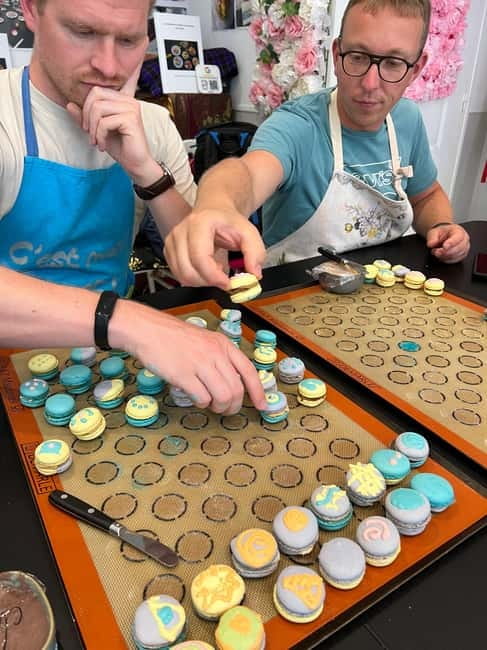
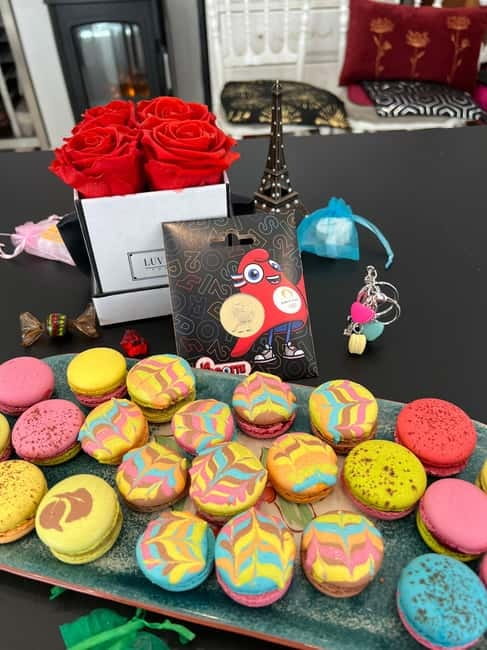
French macarons look delicate, but this two-hour hands-on class gets you right into the tricky parts: Italian meringue, smooth macaronage, neat piping, and filling. You make your own shells, decorate them with a double nozzle, and leave with at least 15 macarons in a box. Kanika and Vouthy lead the class in English or French, with plenty of guidance for first-timers.
I like the small eight-person group and the freedom to use different colors, designs, and fillings. I also like that this is a real working lesson, not a short demonstration followed by a single sample. The main drawback is that macarons demand precision, so your finished shells may not all look bakery-perfect. Also, the class is not suitable for people with food allergies or lactose intolerance.
Key points for your Paris itinerary
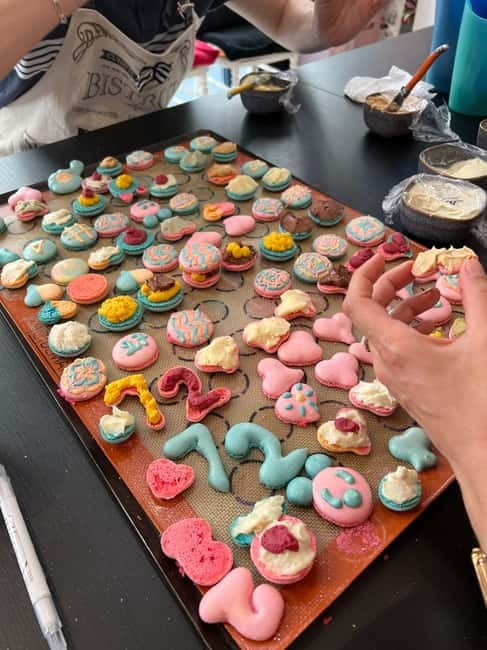
- At least 15 macarons to take home: Each participant prepares a personal box, and some class members have made more than the stated minimum.
- Italian meringue technique: You learn a dependable method, plus tips for making macarons successfully in your own kitchen.
- Ten filling choices: The fillings add variety, with raspberry ganache, mango-passion ganache, and even savory options such as French cheese available in the class.
- Small group of eight: The format gives you more direct help with piping, folding, and troubleshooting.
- Convenient Montmartre pairing: The class begins at Maca’Rong, 175 Rue Legendre, with Montmartre about a 20-minute walk away.
- Family-friendly, with limits: Children under six cannot attend, and every person in the room must have a reservation.
Making macarons at 175 Rue Legendre
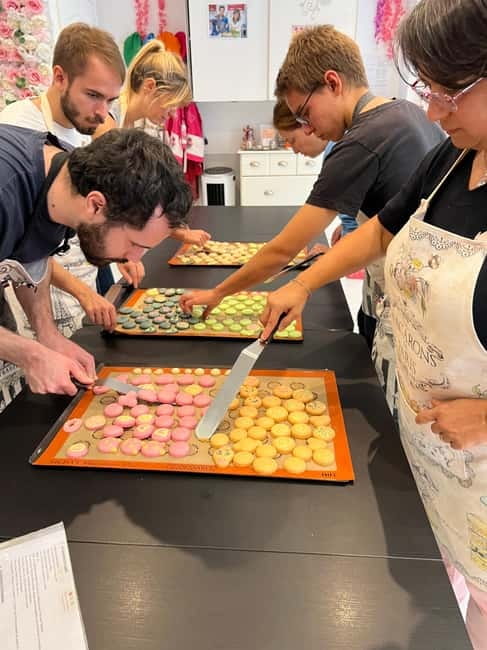
Your class begins inside the Maca’Rong shop on the ground floor at 175 Rue Legendre. You do not need to report to a separate kitchen or hunt for a hidden meeting point. Simply enter the shop and join the class.
The room is set up with a bowl of tant pour tant ingredients for each participant. In pastry language, that means the basic almond and sugar mixture used for macaron shells. Having your own prepared bowl keeps the class moving and lets you focus on technique rather than measuring every ingredient from scratch.
That matters in a two-hour workshop. You get a proper lesson without spending the whole afternoon weighing ingredients. At the same time, the class does not skip the steps that usually cause trouble at home.
Kanika and Vouthy teach in English and French. Their friendly, patient approach is especially useful when the instructions become technical. One instructor may demonstrate while the other helps individual participants, which is one reason the small group size works well.
Tea, coffee, and macarons are included. You also receive a secret recipe, so the class has value after your Paris visit. This is not just a pleasant way to eat sweets for an afternoon. You get a method you can try again in your own kitchen.
More Workshops in Paris
- Fragonard Paris: Mini Perfume Workshop
★ 4.5 · 1,924 reviews - Paris: 2-Hour Perfume Creation Workshop
★ 4.8 · 731 reviews - Paris: 45-minute Chocolate Making Workshop at Choco-Story
★ 4.4 · 444 reviews
Italian meringue and the first serious pastry lesson
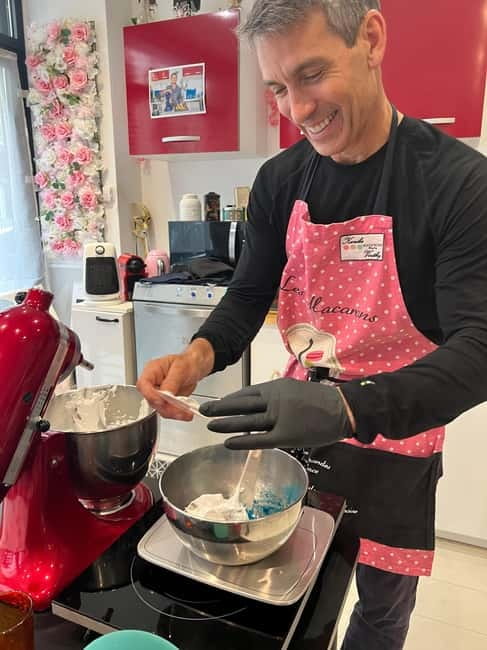
The central technique is Italian meringue. Instead of simply whipping egg whites and sugar together, this method uses a hot sugar syrup. It takes a little more care, but it can produce steady results when handled correctly.
The guide explains the technique step by step and also discusses other macaron methods. That broader explanation is useful if you already bake, since you can compare approaches rather than being told there is only one correct way.
You will need to pay attention here. Italian meringue is the most technical part of the class, and the timing matters. The instructor also shares practical advice for avoiding cracked shells, a problem that can turn an attractive macaron into a rough, hollow-looking cookie.
The class has worked well for complete beginners and for people who already know the French or Swiss macaron methods. That range is a good sign for mixed groups. A first-time baker can follow the demonstration, while a more experienced baker can focus on the finer points of consistency and piping.
Macaronage: the moment the batter changes
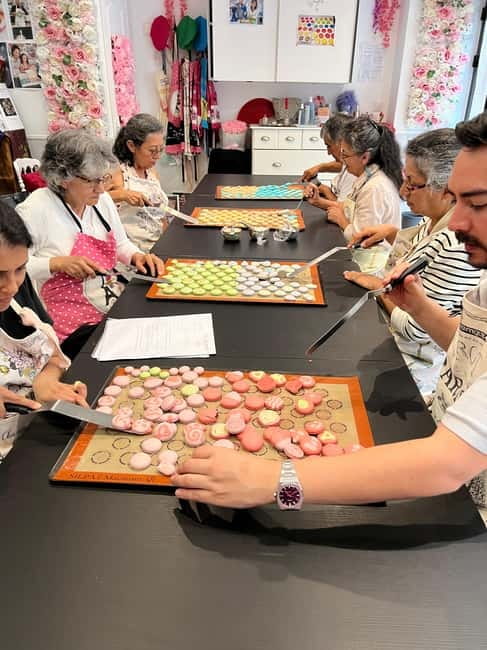
Once the meringue is ready, you combine it with the tant pour tant mixture. This folding process is called macaronage, and it is where many home bakers lose control of the batter.
Fold too little and the mixture stays thick. Fold too much and it becomes loose, making it hard to pipe clean circles. The goal is a glossy batter with the right flow. The class teaches you to recognize that shiny texture before you move to the piping bag.
I like this part because it explains why the recipe is not just a list of measurements. Two batches can use the same ingredients and still behave differently if the folding is off. The instructor shows what you are looking for instead of leaving you to guess.
You also learn how to fill the piping bag without creating unnecessary waste. That sounds like a small point, but it makes the class more useful at home. Piping bags can be awkward, especially when you are trying to control a thick mixture with one hand while scraping the bowl with the other.
Piping round shells and adding your own designs
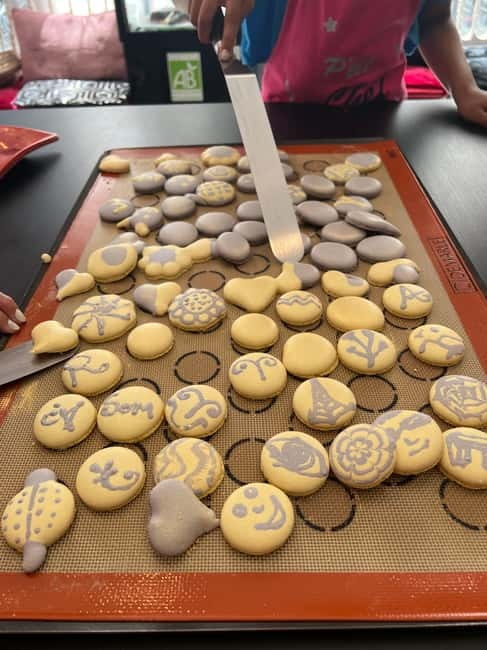
The first piping exercise uses round templates. This gives you a target and helps you practice pressure, size, and spacing. You pipe one shell, stop the flow, and aim for a smooth finish rather than a pointed peak.
After that, the creative part begins. A smaller double nozzle lets you add patterns and personal details to the shells. You can vary the look of your macarons instead of producing a box of identical plain rounds.
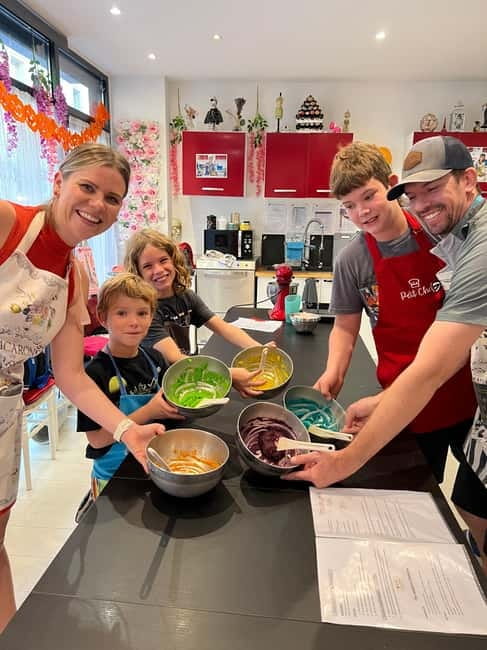
This is where the class feels less like a pastry lecture and more like an activity you can share with your family. Children and teenagers can take part in the decorating, while adults can concentrate on getting an even shape. The result may be slightly uneven, but that is part of the fun.
The instructors are patient with beginners. Several age groups can work together, although children under six are not allowed. Families with children around school age, teenagers, parents, and grandparents have all found roles for themselves in the process.
Keep your expectations sensible. Macaron piping requires a steady hand, and not every shell will match the example. The reward is not perfect uniformity. It is learning why the batter behaves as it does and seeing your own designs come out of the oven.
More Montmartre walks and Sacre-Coeur visits:
- Montmartre Hidden Gems and Scenic Highlights Walking Tour
★ 5.0 · 2,684 reviews - Montmartre Hill French Gourmet Food and Wine Tasting Walking Tour
★ 5.0 · 2,588 reviews - Paris: Montmartre Cheese, Wine & Pastry Guided Walking Tour
★ 4.8 · 2,255 reviews - Paris: Montmartre Highlights Walking Tour with a Local Guide
★ 4.9 · 1,668 reviews
Baking time and the filling demonstration
While the shells bake, the class turns to ganache. The filling may be raspberry or mango-passion, adding fruit flavor and acidity to the sweet shells.
You watch the process rather than spending the entire class making every filling from scratch. That is a smart use of time. The workshop gives you enough hands-on work to understand the cookie, while the demonstration shows how the filling is built and how it changes the final taste.
The class includes ten fillings, giving you a choice of combinations instead of restricting the whole group to one or two flavors. You may also get to taste other fillings prepared by the team, including savory choices such as French cheese. That unusual option is worth noting if you are curious about the wider range of macaron flavors.
Once the shells cool, you pair them, pipe in the filling, and assemble the macarons. This final stage brings together everything you have practiced: matching sizes, handling the shells gently, and using enough filling without squeezing it out the sides.
You receive a special box for your macarons, along with bags for carrying it. The stated amount is at least 15 macarons per person. Some participants have left with more than 20, and a parent-child pair has produced around 40 together, but you should treat 15 as the reliable expectation.
What makes the small group valuable
Eight people is a useful limit for a pastry class. You are not standing at the back of a large room trying to see a single demonstration. The instructors can watch your folding and piping, answer questions, and step in before a small mistake ruins the batch.
The format also suits mixed ability levels. If you have never made macarons, you can ask basic questions without slowing down a large class. If you already bake, you can ask about shell texture, filling choices, or the differences between French, Swiss, and Italian methods.
The atmosphere is relaxed and social. Tea, coffee, and tasting samples give the class a natural rhythm, and the process leaves room for conversation. This can be a useful break from museums and monuments, especially in the middle of a busy Paris schedule.
There is one firm rule: every person taking part must have a reservation. Someone cannot come along simply to watch. That includes family members who may be tempted to sit in the room while others bake.
The instructors have been especially welcoming with families, but you should still decide if your children can manage a precise, two-hour activity. The official minimum age is six, while the class can also suit teenagers and adults. A young child may enjoy the decorating more than the technical meringue work.
The Montmartre connection
The class takes place in the 18th arrondissement, and Montmartre is close enough to pair with your sightseeing. One useful planning detail is that the meeting point is not directly beside the Sacré-Coeur area. Allow about a 20-minute walk to or from Montmartre.
You can schedule the workshop before lunch in Montmartre or use it as a break after exploring the hill. The activity itself ends back at Maca’Rong, so you will need to plan your next stop from 175 Rue Legendre rather than from the top of Montmartre.
That walk can be helpful after eating a box of sweets, but it is worth leaving enough time between the class and any fixed reservation. The workshop lasts two hours, and the starting time changes by date. Check the available start times before you build your day around it.
Do not bring oversize luggage. The class involves work surfaces, equipment, and boxes of macarons, so a small bag is the sensible choice.
Is $150 a fair price?
At $150 per person, this is not a cheap pastry tasting. The value depends on what you want from the experience.
If you only want to eat macarons, a pastry shop will cost less. If you want a box to take home, buying one is also easier and faster. But this workshop gives you two hours of instruction, drinks, multiple fillings, a recipe, a small group setting, and at least 15 macarons that you prepare yourself.
The price makes more sense for families or couples who want an activity rather than another sightseeing stop. It also suits anyone who has tried making macarons at home and wants to fix recurring problems such as cracked shells, poor piping, or loose batter.
The take-home quantity adds practical value, though the macarons are not the only thing you are paying for. You are paying for the ingredients, the equipment, the guidance, and the chance to practice under supervision. If you use the recipe later, the class can continue paying off after your trip.
Keep in mind that macarons are fragile. You get a box and bags, but you should handle them carefully after leaving. If you are flying home soon, the treats are best treated as a short-term souvenir rather than something guaranteed to survive rough luggage handling.
Who should book this workshop?
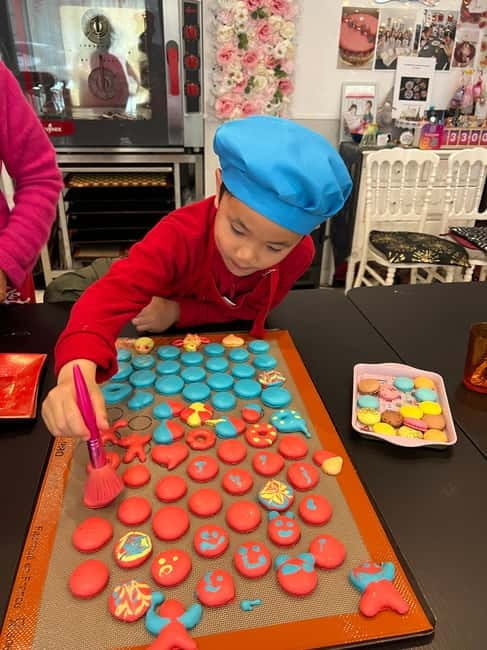
I would choose this for a family seeking a shared activity, especially with children six and older who enjoy making and decorating food. The class has also worked for groups spanning children, parents, and grandparents, since each person can participate at a different level.
It is a good match for a couple who wants a relaxed food experience away from the standard restaurant circuit. It also suits a serious home baker who already knows some macaron methods and wants to compare them with Italian meringue.
You should skip it if you have food allergies or lactose intolerance. The activity is also not suitable for wheelchair users, babies under one year, or children under six. Those limits are important because the class involves ingredients and hands-on kitchen work.
The language choice is English or French. If you are worried about following pastry terms, the small group and demonstrations help, though one instructor’s strong French accent may require extra concentration at times.
Cancellation and booking flexibility
You can cancel up to 24 hours before the activity for a full refund. A reserve-now-and-pay-later option is also available, which helps if your Paris schedule is still changing.
Because the workshop has only eight places, book early if you need a particular day or starting time. Every participant needs an individual reservation, including children who meet the minimum age.
Should you book the Maca’Rong class?
Book it if you want to make something in Paris, not simply look at something. The best parts are the small group, the patient instruction from Kanika and Vouthy, the ten filling choices, and the generous box of handmade macarons at the end.
I would be more cautious if you dislike precise kitchen work or expect every shell to look like it came from a luxury pastry counter. Macarons can be fussy, and the workshop asks you to pay attention.
For families, home bakers, and anyone looking for a memorable two-hour break near Montmartre, the experience offers good value despite the $150 price. Plan your walk, leave the oversize bag at your hotel, and arrive ready to squeeze a piping bag.
FAQ
How long does the macaron workshop last?
The workshop lasts two hours. Starting times vary, so check the available options when booking.
Where does the class begin?
The class begins at the Maca’Rong shop on the ground floor at 175 Rue Legendre in Paris.
How many macarons do I take home?
You are scheduled to take home at least 15 macarons in a special box. The final number can be higher depending on your piping and the amount produced.
What languages are available?
The class is taught in English and French.
Is the workshop suitable for beginners?
Yes. The class teaches the Italian meringue method, macaronage, piping, decoration, and filling techniques, with guidance throughout.
What flavors and fillings are included?
The class includes 10 fillings. The filling demonstration may feature raspberry or mango-passion ganache, and other options, including French cheese filling, may be available to taste.
Can I attend just to watch someone else?
No. Every person in the workshop must have a reservation. You cannot stay only as an observer.
Is the class suitable for children and people with dietary restrictions?
Children under six cannot attend. The activity is not suitable for people with food allergies, lactose intolerance, wheelchair users, or babies under one year.
More Pastry and Chocolate Tours in Paris
- Paris: Day or Sunset Cruise with Drink, Ice Cream or Dessert
★ 4.4 · 4,225 reviews - Award-Winning Paris French Bakery Experience — Le Marais, 4th Arr
★ 4.5 · 1,186 reviews - Paris: Entrance Ticket to the Chocolate Museum
★ 4.1 · 1,105 reviews - Private Montmartre Food Tour with Wine, Cheese & Pastries
★ 5.0 · 1,027 reviews
Just added around Paris
- Paris Private Custom Tour with a Local Guide, Hidden Gems & Highlights★ 5.0 · 293 reviews
- Explore Hidden bars and Speakeasies in Paris★ 5.0 · 79 reviews
- Paris French Baking Class Baguettes and Croissants in a Bakery★ 4.5 · 172 reviews
- Paris: Experience Segway Top Highlights Small Group 2 Hours★ 5.0 · 75 reviews
- Seine River Evening Cruise with Music (Drink Options)★ 3.5 · 321 reviews
- Eiffel Tower Tour & River Cruise with Summit Option★ 4.0 · 215 reviews
- Paris Evening City of Lights Small Group Bike Tour & Boat Cruise★ 5.0 · 97 reviews
- Paris Eternelle Notre-Dame Virtual Reality Tour★ 4.5 · 50 reviews
Montmartre Tours, compared.

Montmartre Hidden Gems and Scenic Highlights Walking Tour
Read our review →
Montmartre Hill French Gourmet Food and Wine Tasting Walking Tour
Read our review →
Montmartre Cheese, Wine & Pastry Guided Walking Tour
Read our review →
Montmartre Highlights Walking Tour with a Local Guide
Read our review →
Sacré-Coeur and Montmartre Tour with Expert Guide
Read our review →
Private Montmartre Food Tour with Wine, Cheese & Pastries
Read our review →
Paris Montmartre Food Tour – A Full French Meal by Do Eat Better
Read our review →
Hidden Montmartre: Paris’ Secret Streets Walking Tour
Read our review →Browse the lists this tour appears in