
Reviewed · MONTMARTRE TOURS
Montmartre Hidden Gems and Scenic Highlights Walking Tour
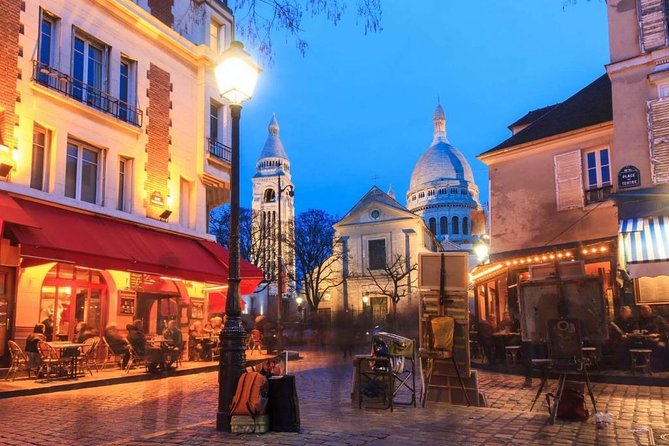
Montmartre is best understood on foot, one steep little street at a time. This 90-minute walk links its artists’ studios, old windmills, vineyard, cafés, and grand white basilica, while your guide fills in the personalities behind the walls and doorways. It is a quick way to get your bearings in one of Paris’s most atmospheric neighborhoods.
I like the artist stories, especially the stops tied to Picasso, Modigliani, Braque, Renoir, Van Gogh, and Dalida. I also like the route’s practical finish near Sacré-Cœur and Place du Tertre, where you can continue exploring, enter the basilica on your own, or stop for lunch.
The main caution is pace and terrain. The route is listed as having no stairs, but it does include hills, narrow streets, and uneven Montmartre footing. One unhappy participant also felt the guide spent too much time on street art and too little time walking between major sights, so this tour suits you best if you want stories and context, not a checklist of every famous stop.
At a glance
- A 90-minute introduction: You cover a compact section of Montmartre without giving up half a day.
- Artists at the center: Bateau-Lavoir connects the walk to Picasso, Modigliani, and Braque, while Moulin de la Galette recalls Renoir and Van Gogh.
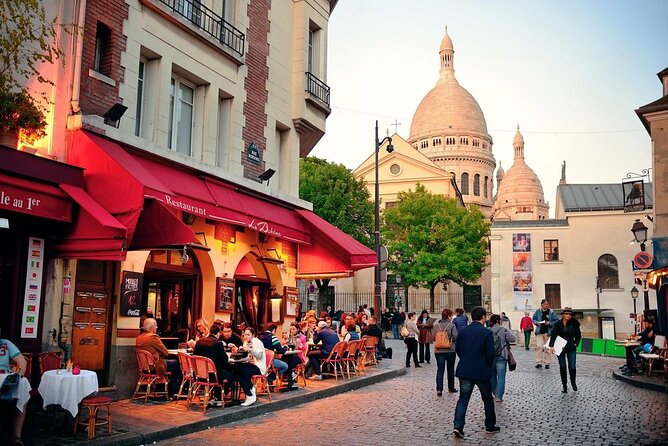
- More than the famous basilica: The route includes the I Love You Wall, Dalida’s bust, La Maison Rose, and Montmartre’s small vineyard.
- Sacré-Cœur from outside: You receive advice for a later self-guided visit, but entry into the basilica is not included.
- A useful end point: The walk finishes at La Bonne Franquette, close to Place du Tertre and the basilica.
- A group of up to 25: That is manageable, but you will want to stay close to the guide on crowded streets.
Why this short walk works in Montmartre

Montmartre can feel confusing on a first visit. The neighborhood rises above northern Paris, and its streets change quickly from busy café lanes to quiet corners, old houses, and steep passages. A map shows you where to go, but it does not explain why a plain building mattered to modern art or why a bronze bust has fresh flowers around it.
That is where this tour earns its price. At $38.70 per person, you are paying for a local guide, an English explanation of the neighborhood, and a route that connects places you might otherwise pass without noticing. The walk does not include museum admission or a long interior visit, so its value comes from orientation, storytelling, and saved time.
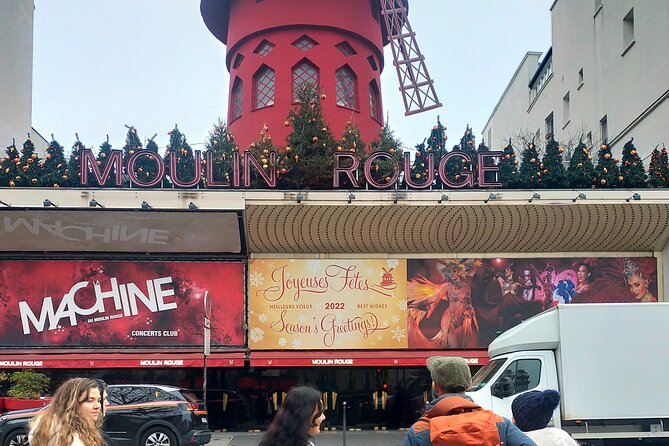
I would call it a good first look rather than a complete Montmartre visit. In 90 minutes, you get a strong outline of the neighborhood, but you will not linger long at every stop. If you want the Moulin Rouge, the funicular, or a detailed visit inside Sacré-Cœur, you will need to add those yourself.
The guide makes a large difference. Laura is praised for her easy storytelling and sense of humor. Denise is noted for clear explanations and helpful answers. Sylvia is described as engaging and good at offering advice about the area, while David receives praise for keeping the group together and explaining the art and history. Other named guides include Linda, Ben, Sonia, Tetiana, Anastasia, Katie, and Sophie.
Because the guide may vary, the exact personality of the walk will vary too. The consistent aim is clear: show you the parts of Montmartre that explain its artistic and local character, not simply march you to the basilica for a photograph.
More Walking Tours in Paris
- Paris Top Sights Half Day Walking Tour with a Fun Guide
★ 5.0 · 2,893 reviews - Montmartre Hill French Gourmet Food and Wine Tasting Walking Tour
★ 5.0 · 2,588 reviews - Paris Île de la Cité and Notre-Dame Walking Tour With Crypt
★ 5.0 · 2,272 reviews
Starting at Rue des Abbesses
The meeting point is 19 Rue des Abbesses. Arrive 15 minutes early because the tour starts on time, and you may not be able to catch up if you are late.
Rue des Abbesses gives you a fitting beginning. It is one of Montmartre’s older streets, lined with cafés, shops, and historic buildings. Your guide uses the area to explain how Montmartre developed a bohemian reputation and how that image has changed as the neighborhood became one of Paris’s more expensive addresses.
This change is one of the more useful themes of the walk. You hear about a district once associated with cheap rents and working artists, then see the cafés, restaurants, and desirable streets that now draw large crowds. The contrast helps you look past the postcard version of Montmartre.
The I Love You Wall and a quieter side of Paris

The I Love You Wall sits in a small square and displays the phrase in more than 300 languages. It is a brief stop, but it gives the tour an easy visual opening and a chance to reflect on Montmartre’s modern public art.
Do not expect a long art lesson here. The value is that the stop gives you a quick photograph and a simple reminder that Montmartre is not frozen in its nineteenth-century past. It still uses small public spaces for art, romance, and neighborhood life.
From here, the route moves through narrow streets. Stay near your guide, especially when the group is spread out by café tables, parked cars, or other pedestrians. A group of up to 25 is not enormous, but sound can be lost quickly in a tight street.
Bateau-Lavoir and Montmartre’s painters
Bateau-Lavoir is one of the most important historical stops. It was once a modest artists’ residence where Picasso, Modigliani, and Braque lived and worked. These artists helped reshape modern art, making this otherwise unassuming location far more important than its exterior suggests.
This is exactly the kind of stop that works better with a guide. If you walked past alone, you might see another old building. With context, you can connect the address to the experiments and arguments that changed European art.
The tour does not replace a museum visit. Instead, it gives you a street-level understanding of why so many artists gathered in Montmartre. You begin to see the neighborhood as a workplace and social world, not just a pretty hill with souvenir shops.
More Montmartre walks and Sacre-Coeur visits:
- Paris: Montmartre Cheese, Wine & Pastry Guided Walking Tour
★ 4.8 · 2,255 reviews - Paris: Montmartre Highlights Walking Tour with a Local Guide
★ 4.9 · 1,668 reviews - Private Montmartre Food Tour with Wine, Cheese & Pastries
★ 5.0 · 1,027 reviews - Paris: Sacré-Coeur and Montmartre Tour with Expert Guide
★ 4.1 · 1,027 reviews
Moulin de la Galette and the old dance-hall spirit
Moulin de la Galette is one of Montmartre’s best-known symbols. The windmill appears in paintings by Renoir and Van Gogh and recalls a time when the hill had a more rural feel. It also served as a dance hall, giving the site a lively social past.
You see the Moulin de la Galette from outside. That matters when planning your expectations. The stop is about the story, the setting, and the chance to connect a real Paris street with famous paintings, not about entering a working mill.
I like this part of the route because it shows how Montmartre has changed without losing every trace of its old identity. A windmill in a city neighborhood sounds unlikely, yet here it becomes a useful clue to the hill’s former village character.
A man through a wall and Dalida’s Montmartre
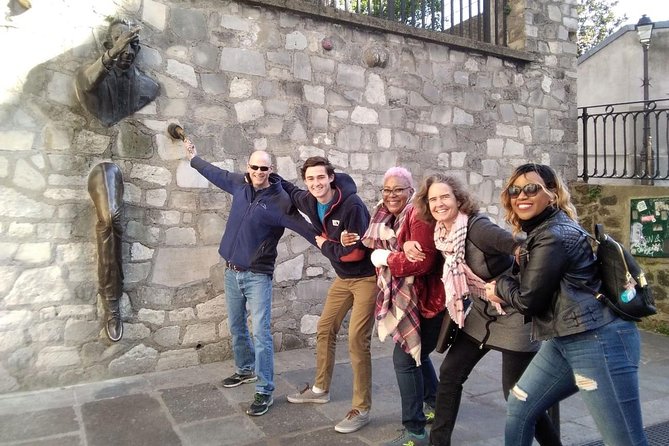
Near Marcel Aymé’s former home, you find a whimsical sculpture of a man walking through a wall. It comes from one of the author’s short stories and suits Montmartre’s taste for the strange and playful.
This stop is small and easy to miss alone. Your guide can point out why the sculpture is there and connect it to the neighborhood’s long association with artists, writers, and surreal ideas. It is also a welcome change from grand monuments. Montmartre’s personality often appears in modest corners.
The walk then reaches the bust of Dalida, the French singer who lived in Montmartre for many years. Her bronze portrait sits in a peaceful square and has become a place where fans leave tributes. This gives the tour a broader cultural range. Montmartre is not only a story about painters from the early twentieth century. It also belongs to performers and musicians who made the neighborhood their home.
La Maison Rose and the vineyard
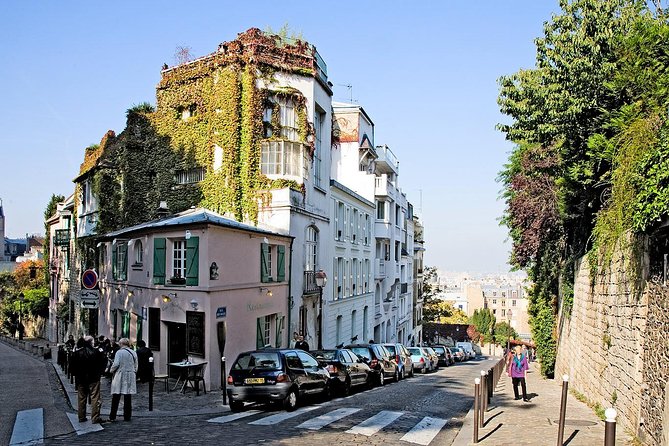
La Maison Rose is one of Montmartre’s most photographed buildings. Its pink exterior has long been linked with the neighborhood’s artistic life, and the café was associated with figures such as Picasso and Utrillo. Today it serves French food, so you can return for a meal if the setting appeals to you.
The stop is partly about the photograph, but it also helps explain why Montmartre remains so appealing. Bright façades, small lanes, and stories of artists create a place that feels different from the grand boulevards below. Just remember that the café is not included as part of the tour.
The nearby vineyard offers another surprise. Montmartre still has a small wine-growing plot, established in 1933 to protect the area’s winemaking tradition. It is not a large vineyard visit or a tasting experience. Instead, it is a reminder that this hill once had a rural side and still preserves a small piece of it.
These two stops work well together. La Maison Rose shows the Montmartre of artists and cafés. The vineyard recalls the village that came before the modern tourist district. Together, they give you a better sense of the neighborhood’s layers.
Sacré-Cœur from outside, then onward
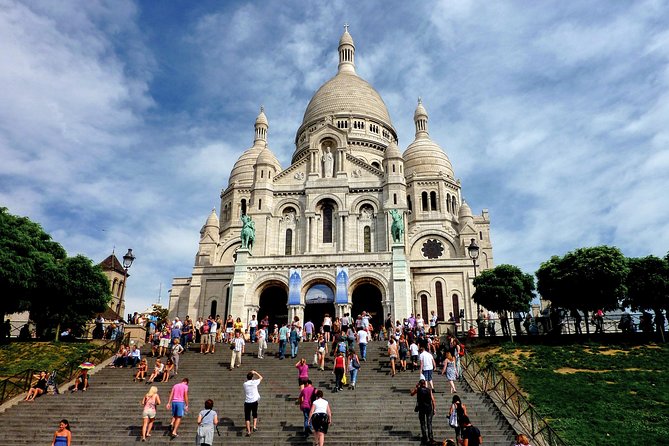
The tour passes the exterior of Sacré-Cœur Basilica, built in the late nineteenth century. Its white domes and mosaics make it one of the most recognizable sights in Paris, and its position near the highest point in the city gives you broad views across Paris.
Entry is free when the basilica is open, but it is not part of the guided tour. Your guide can explain what to look for inside and help you decide how to continue after the group ends. Plan extra time if you want to enter, sit quietly, or see the interior mosaics without rushing.
This arrangement has both benefits and limits. You keep the guided portion to 90 minutes, which is useful when your Paris schedule is tight. On the other hand, you must handle the basilica visit yourself, and the tour does not include a guided explanation inside.
The view is one of the walk’s best rewards. Depending on the weather, you can look out across the city from Montmartre’s high ground. One practical tip is to choose an early departure if you have the option. The area becomes crowded quickly, and an early walk makes it easier to hear the guide and take in the view.
Place du Tertre and the final stop
The route ends at La Bonne Franquette, at 18 Rue Saint-Rustique. You are close to Place du Tertre, the lively square associated with painters, caricaturists, cafés, and restaurants.
Place du Tertre can be crowded and commercial, but it remains a useful place to finish. You can see the public side of Montmartre’s art tradition, compare the square with the quieter streets you have just walked, and decide where to spend the rest of your time.
Several guides offer suggestions for lunch, restaurants, and additional sights. That practical advice can be valuable because Montmartre has many places competing for your attention. The tour does not include a meal, but its ending makes it easy to continue with one.
Hills, footing, and group size
The official route does not include stairs, but it is not flat. You will handle several hills and narrow streets, and Montmartre generally includes uneven paving and busy sections. A moderate level of fitness is recommended.
If you use a wheelchair or have trouble with steep grades, ask for detailed route information before booking. One account described the cobbled streets and slopes as very difficult for a wheelchair user, even with assistance. The supplied route information says there are no stairs on the tour, but that should not be mistaken for full accessibility.
The tour runs in all weather. Wear shoes suited to hills and check the forecast before leaving. A light rain jacket can matter more here than an elegant but slippery pair of shoes.
The maximum group size is 25. That keeps the walk within a reasonable size, though one person found a large group made it hard to hear. If you have hearing concerns, stay near the guide and choose an early tour when possible.
Is $38.70 a fair price?
For Paris, $38.70 is a reasonable price for a focused small-neighborhood walk, especially if you are new to Montmartre and want someone to explain what you are seeing. The 90-minute length also limits the cost in time. You can take the tour in the morning and still have most of the day for Sacré-Cœur, lunch, museums, or another part of Paris.
The price is less attractive if you want entry tickets, a meal, or a deep art-history lecture. None of those is included. You are buying a guided introduction with outdoor stops and practical advice.
I see the best value in the connections between places. The I Love You Wall, Bateau-Lavoir, Moulin de la Galette, Dalida’s bust, La Maison Rose, vineyard, and basilica are more meaningful when a guide explains how they fit into Montmartre’s story. If you already know the neighborhood well, the short format may feel basic.
Free cancellation is available until 24 hours before the start time. Within 24 hours, the payment is not refunded, so keep that deadline in mind when planning around weather or a changing Paris schedule.
Who should book this walk?
I would recommend it to a first-time Paris visitor who wants an introduction to Montmartre without spending several hours on a single neighborhood. It also works well for families of adults, couples, and anyone who prefers local stories to a list of monument dates.
It is a good choice if you want:
- A short orientation before exploring alone
- Stories about artists, writers, and performers
- Help finding small sites you might miss
- Advice about Sacré-Cœur and the area around Place du Tertre
- A walk that ends near cafés and restaurants
I would choose another plan if you mainly want the Moulin Rouge, the funicular, the Sacré-Cœur interior, or the staircase climb. Those are not the focus here. I would also avoid booking it if hills and uneven streets are a serious problem for you.
Should you book it?
Book this tour if you want Montmartre explained through its people and small landmarks, not just photographed from the basilica steps. At $38.70, it offers a useful first pass through the neighborhood, with enough time left to explore on your own.
Skip it if you want a detailed museum-style lecture, a full Sacré-Cœur visit, or every major Montmartre sight in one route. The strongest version of this experience is an early walk with a lively guide such as Laura, Denise, Sylvia, or David, followed by your own time at the basilica, Place du Tertre, and La Bonne Franquette.
FAQ
How long is the Montmartre walking tour?
The tour lasts approximately 90 minutes.
Where does the tour start?
It starts at 19 Rue des Abbesses, 75018 Paris, France. You should arrive 15 minutes early because the tour starts on time.
Where does the tour end?
The tour ends at La Bonne Franquette, 18 Rue Saint-Rustique, near Place du Tertre and Sacré-Cœur.
Is entry to Sacré-Cœur included?
No. The tour passes the exterior of Sacré-Cœur Basilica. Entry is free when the basilica is open, and the guide offers advice for visiting independently afterward.
Does the route include stairs?
The stated route does not include stairs, but it does include hills, narrow streets, and busy areas. You should be comfortable walking on Montmartre’s uneven streets.
What happens if I need to cancel?
You can receive a full refund if you cancel at least 24 hours before the local start time. Cancellations or changes made within 24 hours are not refunded or accepted.
Just added around Paris
- Paris: Croissant Baking Class with a Chef★ 5.0 · 201 reviews
- Cooking Class with a Parisian Chef★ 5.0 · 46 reviews
- Cocktails lessons in Speakeasy★ 4.5 · 72 reviews
- Paris: Choux Pastry and Chocolate Éclair Making Class★ 4.9 · 50 reviews
- Paris: Classic Sites Tour by Vintage Citroen 2CV★ 4.6 · 189 reviews
- Paris: Cheese and Wine Class in a 17th Century Cellar★ 4.8 · 91 reviews
- Paris: Romantic Photoshoot for Couples★ 4.9 · 131 reviews
- Paris: Bread and Croissant-Making Class★ 4.8 · 206 reviews
Montmartre Tours, compared.
Montmartre Hill French Gourmet Food and Wine Tasting Walking Tour
Read our review →
Montmartre Cheese, Wine & Pastry Guided Walking Tour
Read our review →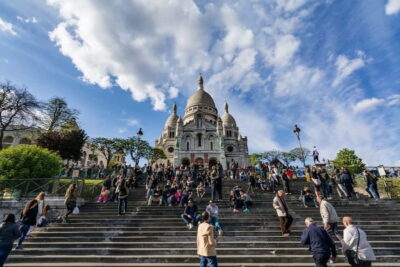
Montmartre Highlights Walking Tour with a Local Guide
Read our review →
Sacré-Coeur and Montmartre Tour with Expert Guide
Read our review →
Private Montmartre Food Tour with Wine, Cheese & Pastries
Read our review →
Paris Montmartre Food Tour – A Full French Meal by Do Eat Better
Read our review →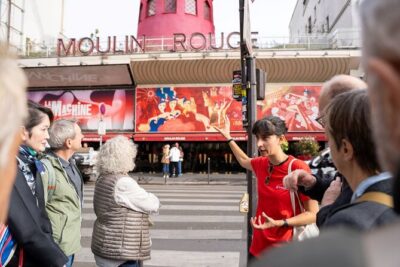
Hidden Montmartre: Paris’ Secret Streets Walking Tour
Read our review →
Paris Montmartre Food & Wine Tour with Eating Europe
Read our review →Browse the lists this tour appears in