
Reviewed · SEINE RIVER CRUISES
Seine River Direct Access Guided Cruise
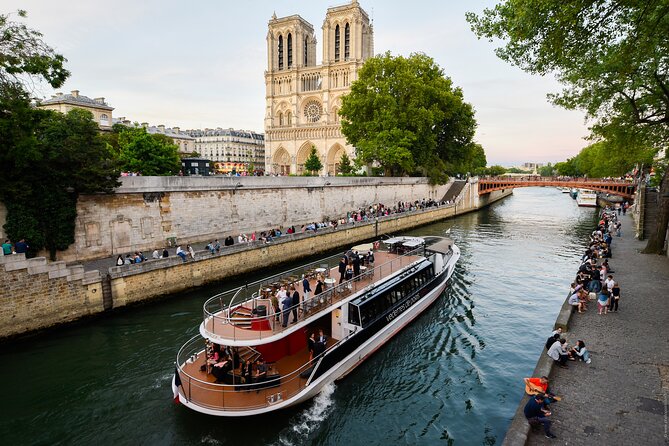
The best thing about this one-hour Seine cruise is its front-row view of Paris. From the water, the Eiffel Tower, Notre-Dame, Louvre, bridges, and grand riverside buildings line up in a way that is hard to grasp on foot. The boat leaves from 2 Port de Suffren, close to the Eiffel Tower, and returns there after the ride.
I like the 100% electric boat, which keeps the trip quiet enough for sightseeing, and I like the live guide who usually explains the landmarks in both French and English. Champagne and other refreshments are available onboard, too. The main drawback is that bilingual commentary takes time in two languages, and some passengers have found the English hard to hear or understand.
Key points to know before you book
- The route packs in major Paris sights: You see the Eiffel Tower, Invalides, Alexandre III Bridge, the Louvre, Notre-Dame, and more from the Seine.
- A quiet electric boat carries up to 220 people: The ride is calmer than a standard motorboat, though the upper deck can fill quickly.
- Live commentary is usually bilingual: Guides explain the sights in French and English, but announcements may be harder to follow when the boat is crowded.
- Morning departures can be a smart choice: Early rides have often been less crowded, with better chances for an open seat and clear photographs.
- The views change with the weather: The enclosed area helps in cold conditions, while the open upper deck gives better pictures but can be windy.
- The price is modest for central Paris: At about $25.23 per person, it offers a useful orientation without taking half a day.
A quiet hour on the Seine
Paris can be tiring. You spend the morning crossing streets, climbing museum stairs, and trying to keep up with a map that seems to change every few minutes. This cruise gives you a seated hour with a steady view of the city.
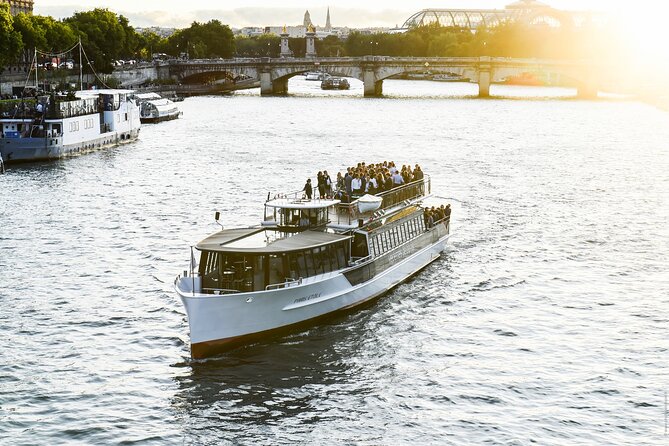
The boat is designed for sightseeing, with panoramic windows and outside viewing areas. On a cool day, the enclosed section can be warm and comfortable. On a sunny day, it may feel hot before departure, especially if the boat is full and the air is still. Once the boat moves, the river breeze helps.
I would arrive early if you care about your seat. The upper deck offers the clearest photographs, but boarding order matters. If you arrive only a few minutes before boarding closes, you may end up below the top deck. That is not necessarily a bad place to sit: the lower outdoor area can offer shade and a pleasant breeze.
The cruise usually takes about one hour. That is long enough to cover a useful stretch of the Seine, but short enough to fit before a museum visit, after lunch, or on your last evening in Paris. Morning and afternoon departures make it easier to fit into a busy itinerary.
More Boat Tours in Paris
- Paris: Evening River Cruise with Music
★ 4.4 · 22,721 reviews - Paris: Louvre Guided Tour with Reserved Access & Boat Cruise
★ 4.3 · 16,353 reviews - Paris: Big Bus Hop-On Hop-Off Tour with Optional Cruise
★ 4.4 · 13,279 reviews
The Eiffel Tower gives the ride its opening punch
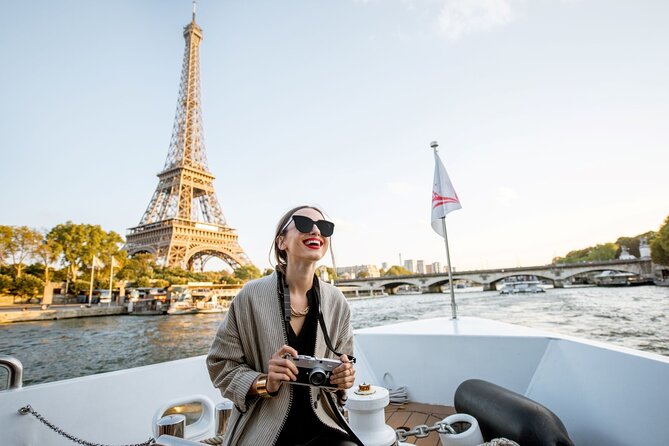
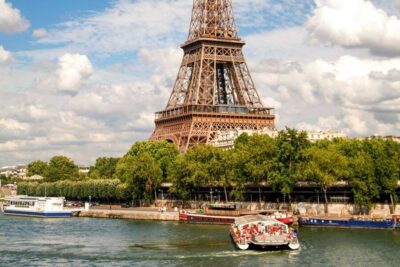
The Eiffel Tower is the natural star of the route. Built for the 1889 Universal Exhibition by engineer Gustave Eiffel, it took only two years, two months, and five days to complete. At 324 meters tall, it was an astonishing metal structure for its time, and many Parisians disliked its appearance and height.
The tower was meant to last only 20 years. A radio antenna added in 1903 helped save it from demolition, and it later became the symbol most closely tied to Paris.
From the Seine, you see the tower in context, rising above the city rather than from the crowded platform beneath it. This is one of the strongest reasons to take the cruise near the start of a Paris stay. You get a quick orientation to the river, the nearby monuments, and the way the city is arranged around the water.
For photographs, the open deck is best. Bring a light jacket even in warm weather. Several ride comments point to wind on the top deck in autumn, and the same breeze can catch you on a bright summer day.
From the American Church to Napoleon’s golden dome
The American Church in Paris is easy to miss from the street, but it becomes more visible from the river. Its green clock tower marks the first American church built outside the United States. Its stained-glass windows, created by Louis Comfort Tiffany, are listed as historic monuments.
Next comes the Hôtel des Invalides, recognizable by its golden dome. Louis XIV ordered the complex as a hospital for wounded soldiers and officers. Today, the royal chapel contains the tomb of Napoleon I, France’s first emperor.
The view is brief, so the guide’s narration matters here. You are not stopping to explore either building, and you will not have time to study architectural details. Think of this part of the cruise as a fast introduction, then return later if a particular monument catches your attention.
Alexandre III Bridge and Pont de la Concorde
The Alexandre III Bridge is one of the most ornate crossings in Paris. It was built for the 1900 Universal Exhibition and celebrated the Franco-Russian Alliance. Its decoration includes the Paris coat of arms in gold leaf and figures representing the Seine. Across the bridge, the symbols refer to Saint Petersburg and the Neva River.
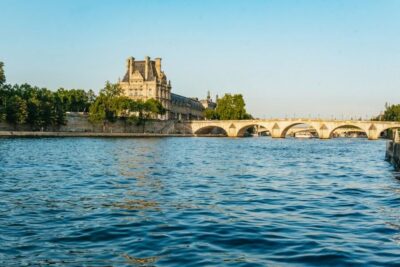
This is a particularly good section for photographs. The bridge’s lamps, sculptures, and gilded details are easier to appreciate from the water than from a crowded pavement. You also get a clear view beneath its broad arch as the boat passes.
Pont de la Concorde has a more political story. Some of its stones came from the Bastille after the prison was stormed in 1789 during the French Revolution. The bridge connects to the Palais Bourbon, home of the National Assembly, on one side and the Place de la Concorde on the other.
The boat does not turn these places into full visits. You are seeing them in passing, with a guide providing the short version. That is a strength if you want a wide survey, but a limitation if you prefer long explanations about each monument.
More cruises along the Seine:
- Paris: Seine Cruise & Crepe Tasting near the Eiffel Tower
★ 4.4 · 11,231 reviews - Paris: Seine River Panoramic Views Dinner Cruise
★ 4.3 · 10,611 reviews - Paris: Eiffel Tower Access by Elevator & Seine River Cruise
★ 4.6 · 7,329 reviews - Paris: 3-Course-Dinner Cruise on the Seine with live music
★ 4.7 · 7,248 reviews
Musée d’Orsay and the Institut de France
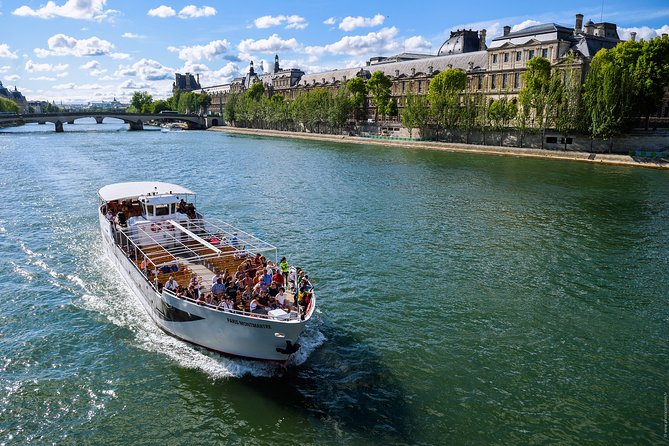
The former Orsay railway station was built for the 1900 Universal Exhibition. Its railway line once ran toward southwestern France. In the 1980s, the building became the Musée d’Orsay, now known for 19th-century art by painters including Renoir, Monet, and Van Gogh.
The museum’s riverside façade is an excellent example of how Paris reuses old buildings. From a boat, you see the scale of the former station and understand why its huge clock and long frontage suit a museum.
The Institut de France occupies the former Collège des Quatre Nations. Cardinal Mazarin left money for its construction in 1661. It houses five academies, including the Académie Française, whose members help update the official French dictionary.
This stop adds a useful reminder that the Seine is not just a line of famous monuments. It also runs past institutions that shape French culture, government, art, and language.
Pont Neuf, the oldest new bridge in Paris
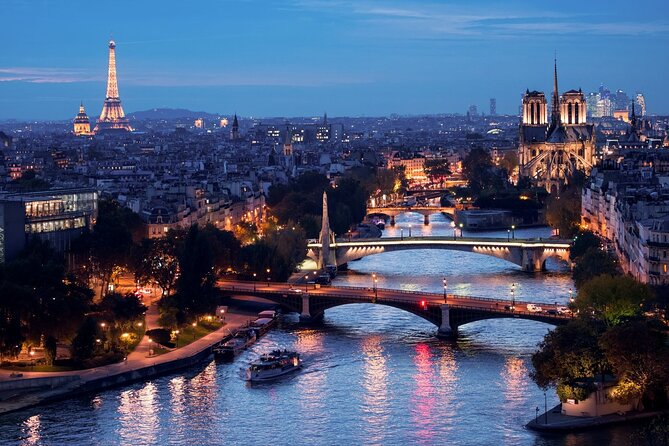
The Pont Neuf translates as New Bridge, but it is actually the oldest bridge in Paris. It was the first Parisian bridge built in stone with pavements instead of houses lining the crossing.
Look for the 381 grimacing stone masks along the bridge. Each one is different. From the river, you may not count them, but the carved faces give the bridge a playful edge that can be lost when you hurry across it on foot.
The bridge is also a good marker for the historic center of Paris. Beyond it, the city begins to feel older and more layered, with the islands, cathedral, medieval streets, and government buildings close together.
Île de la Cité and Notre-Dame
Île de la Cité is traditionally regarded as the birthplace of Paris. The Parisii tribe settled here about 300 years before the Common Era and called the settlement Lutetia.
The island’s most famous building is Notre-Dame Cathedral. Construction began in 1163 and finished nearly two centuries later, in 1345. Its Gothic design includes gargoyles, sculpture, and the south rose window, known as the Rose du Midi. The window focuses on the New Testament and was given by Saint Louis, the French king.
The cruise gives you an important exterior view but does not function as a cathedral tour. Notre-Dame is listed as a free-admission stop in the route information, but this boat ride does not include a dedicated interior visit or extended time ashore. If you want to enter, plan that separately and check current visiting arrangements before you go.
From the water, the cathedral’s position on the island makes sense. You can see why this small piece of land became such an important center for Paris. The river frames the building on both sides, giving you a better sense of its scale than a close view from the square alone.
Saint Genevieve, the Arab World Institute, and Île Saint-Louis
The Tournelle Bridge carries a statue of Saint Genevieve, patron saint of Paris. The statue faces away from the boat, which makes the guide’s explanation useful. Its sculptor, Paul Landowski, also created Christ the Redeemer in Rio de Janeiro.
The Arab World Institute opened in 1987 under President François Mitterrand. Its work covers the history, art, society, religions, and science of the Arab world. The building is a modern counterpoint to the older stone bridges and churches nearby.
Île Saint-Louis feels more residential and refined. Its 17th-century town houses include the Hôtel Lambert and Hôtel Lauzun. Writers and musicians such as Charles Baudelaire and Georges Moustaki once lived on the island.
This stretch is less about one famous postcard view and more about the texture of central Paris. You see elegant façades, narrow riverbanks, and a quieter side of the city between larger monuments.
Hôtel de Ville and the Louvre
The Hôtel de Ville has been the seat of Paris’s city council since 1357. Its current design draws heavily from the Neo-Renaissance style. The building is open to visitors at certain times, and its banquet hall was modeled on the Hall of Mirrors at Versailles.
The Louvre follows, and the river gives you a useful outside view of its enormous scale. Once a royal palace, it became a museum in 1793. The complex has more than four kilometers of façades and nearly 14 kilometers of galleries, with about 38,000 works that include the Mona Lisa, Venus de Milo, and Winged Victory of Samothrace.
Do not confuse seeing the Louvre from the boat with visiting the museum. The cruise helps you understand the palace’s relationship to the river and the surrounding city, but it cannot prepare you for the museum’s full size. If you plan to visit inside, allow several hours and make a separate plan.
Concorde, Grand Palais, and the view toward Trocadéro
Place de la Concorde carries some of the darkest history on the route. Louis XVI and Marie-Antoinette were executed here during the French Revolution. The square’s central obelisk came from Luxor in Egypt and is about 34 centuries old. France brought it to Paris in 1836.
The Grand Palais was also built for the 1900 Universal Exhibition. Its great glass roof was considered the largest in Europe. Today, the building hosts cultural events, exhibitions, a funfair, and a large skating rink.
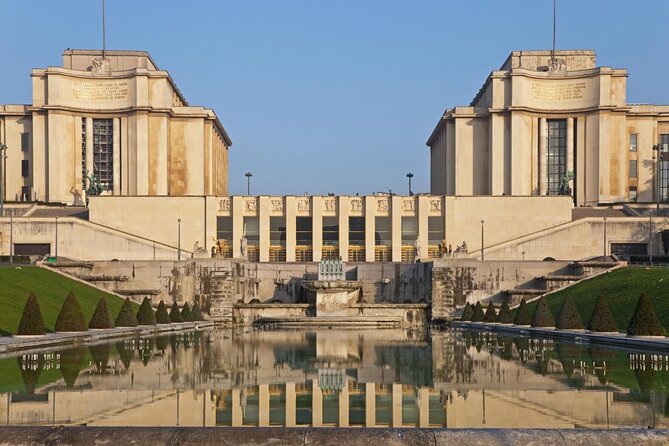
The final major view is the Palais de Chaillot at Trocadéro. Built for the 1937 Universal Exhibition, it consists of two Neoclassical pavilions framing an esplanade above the Trocadéro gardens. Its institutions include the City of Architecture and Heritage, the National Navy Museum, the Museum of Humankind, and the National Theatre of Chaillot.
The route closes with a broad sweep of Parisian architecture, from royal buildings and revolutionary sites to exhibition halls and modern cultural centers. Then the boat returns to 2 Port de Suffren.
Commentary, comfort, and the onboard atmosphere
The live guide is central to the experience. The guides commonly speak French and English, explaining the same sights in both languages. That makes the cruise useful for mixed-language groups, but it also means half the commentary is not in the language you are following.
I would sit close enough to the guide to hear clearly and keep conversations around you to a minimum. Some rides have had excellent narration that held a child’s attention, while other departures have been harder to understand because of accent, delivery, or background noise.
The boat has panoramic windows and an onboard café. Champagne can be purchased, including a glass of Duval-Leroy if selected, and alcoholic drinks are served only to people aged 18 and over. Minors receive non-alcoholic drinks.
The boat can carry up to 220 people. That is a fairly large possible group, although some morning rides have felt spacious and easy to move around. Weather and season make a big difference. Cold conditions may mean fewer people onboard, while sunny days can fill the upper deck quickly.
Price, timing, and practical value
At about $25.23 per person, this is a fair price for a central Paris activity lasting roughly one hour. You are paying for transport on the Seine, a live guide, panoramic views, and a simple way to see many major sights without walking between them.
The value is strongest if this is your first time in Paris, if your feet need a rest, or if you want a broad city orientation before choosing which buildings to visit inside. It is less useful if you want an in-depth history lesson or a private, quiet cruise.
The departure point is near public transportation, and the experience returns to the same place. Confirmation is provided at booking, and the activity is suitable for most people. Keep your boarding information handy, arrive early, and do not rely on reaching the boat at the last minute.
Free cancellation is available up to 24 hours before departure for a full refund. Cancellations or changes inside that period are not refunded. Poor weather or failure to meet the minimum number of participants can lead to a rescheduled trip or a full refund. Mechanical problems have also caused occasional cancellations, so check your email before leaving for the dock.
Who should book this Seine cruise?
I would choose this cruise for a first Paris visit, a family that wants a low-effort sightseeing break, or anyone who wants to see major landmarks from a different angle. It also works well on a first morning, when you can use the route to decide which areas deserve more time.
It suits you less if you dislike bilingual narration, need a fully structured indoor experience, or expect a private boat. On hot days, the enclosed area can be uncomfortable before departure. On cool or windy days, the best outdoor views require another layer.
Should you book it?
Book it if you want an affordable, easy introduction to Paris with strong views of the Eiffel Tower, Notre-Dame, the Louvre, and the city’s ornate bridges. Choose a morning departure, arrive early, and bring a windbreaker.
Skip it only if your schedule is extremely tight or you want detailed time inside each monument. For most visitors, one hour on the Seine is a pleasant break from pavement, with enough history and scenery to make the price worthwhile.
FAQ
Where does the Seine cruise start and finish?
The cruise starts at 2 Port de Suffren, 75007 Paris, France, and returns to the same meeting point.
How long does the cruise last?
The cruise lasts approximately one hour.
What is included in the ticket?
The ticket includes a one-hour cruise on a 100% electric boat and a live guide.
Is the commentary available in English?
English is offered. The guide commonly presents the commentary in both French and English.
Can I buy champagne onboard?
Yes. Champagne is available to purchase onboard. Alcoholic drinks are served only to people aged 18 and older, while minors receive non-alcoholic drinks.
How many people can join the cruise?
The activity has a maximum capacity of 220 people.
Can I cancel for a refund?
You can cancel up to 24 hours before the start time for a full refund. Cancellations or changes made less than 24 hours before departure are not accepted for a refund.
Just added around Paris
- Guided and Private Tour of Paris by Golf Cart★ 5.0 · 33 reviews
- Guided Tour of Sacré-Coeur and Montmartre★ 3.5 · 74 reviews
- Paris – Guided Visit & Tasting in a Royal Wine Cellar★ 4.5 · 221 reviews
- Paris E-Scooter Tour with fun & informative guide (small groups)★ 5.0 · 184 reviews
- Paris Pass with over 90 Top Attractions including Notre Dame Tour★ 3.0 · 121 reviews
- 10+ tastings Gourmet Food & Wine Tour in the Heart of Paris★ 5.0 · 88 reviews
- Paris Like a Local: Full-Day Custom Tour with Private Guide★ 5.0 · 62 reviews
- Full Day Private Tour of Paris in a Van with photoshoot included★ 5.0 · 38 reviews
Seine River Cruises, compared.
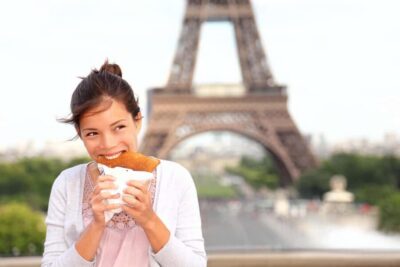
Seine Cruise & Crepe Tasting near the Eiffel Tower
Read our review →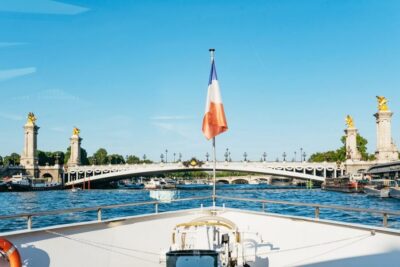
Eiffel Tower Access by Elevator & Seine River Cruise
Read our review →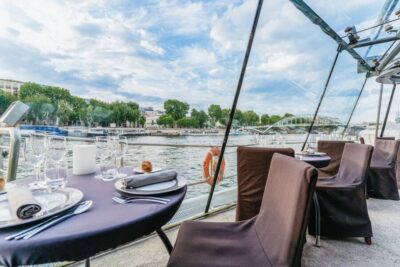
3-Course-Dinner Cruise on the Seine with live music
Read our review →
Bateaux Parisiens Seine River Gourmet Dinner & Sightseeing Cruise
Read our review →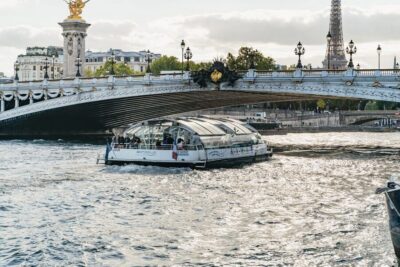
Paris: Hop-On Hop-Off Seine Cruise Pass with 9 Stops
Read our review →
3-Course Gourmet Dinner Cruise on Seine River
Read our review →Browse the lists this tour appears in