
Reviewed · DORDOGNE TOURS
From Sarlat-la-Canéda: Lascaux IV and Cave Art Full-Day Tour
The most remarkable part of this day is the contrast between Rouffignac’s authentic cave setting and Lascaux IV’s painstaking modern replica. One gives you the atmosphere of a real prehistoric cave, while the other lets you see Lascaux’s famous paintings without endangering the original.
I like the small van, limited to eight people, and the way the English-speaking guide provides context between stops. I also like that the tour reaches several major prehistoric sites in one day, including the National Prehistory Museum and La Roque Saint-Christophe. The main drawback is the pace: nine hours is a long day, and English tours inside Lascaux IV are limited, so the cave presentation may be in French.
Key points to know before booking
- Lascaux IV is a full-scale artistic and scientific reconstruction, with painted surfaces made using natural pigments and cave relief reproduced in fine detail.
- Rouffignac gives you a different kind of cave visit, with authentic prehistoric markings and an electric train journey into the cave.
- Les Eyzies is the right place to begin, linking the region’s archaeology with the Cro-Magnon discoveries made here.
- La Roque Saint-Christophe involves stairs, making it unsuitable for wheelchair users or anyone with significant mobility problems.
- The group is small, with transport for up to eight participants and guides such as Anne, Benoit, Lena, and Marion often leading the day.
- Bring a warm layer, since the caves are kept at about 14°C, or 57°F, even in summer.
Why this Dordogne prehistory day works so well
The Dordogne is one of Europe’s great places for learning about early modern humans. The region’s caves, limestone cliffs, and archaeological sites preserve evidence of people who lived here thousands of years ago. This tour gives you several ways to understand that past, rather than sending you straight to one famous attraction and calling it a day.
You begin from the Place Pasteur bus stop in Sarlat-la-Canéda, near La Maison Secrète. From there, the small van heads into the countryside. The drive is part of the lesson. Guides point out local places and explain the area before you arrive, so you are not trying to absorb every fact while standing in a museum gallery or underground chamber.
The tour lasts about nine hours, with roughly 30 minutes of driving at the beginning and end. The full schedule can change because Lascaux IV assigns timed entry slots, but the day normally includes Les Eyzies, Rouffignac, Montignac and Lascaux IV, followed by La Roque Saint-Christophe. The exact order may shift.
That flexibility matters. The prehistoric sites are popular, and the guide has to fit the day around fixed admission times. A good guide keeps the changes from becoming your problem. Anne, Benoit, Lena, Marion, Florence, Martin, and other guides have been praised for keeping the day organized, explaining the area clearly, and handling timetable changes without making the group feel rushed.
A few more Dordogne half-days worth comparing
- Lascaux IV: Full Replica Cave Experience Ticket
★ 4.5 · 334 reviews - Sarlat la Canéda: The Dordogne valley by canoe
★ 4.5 · 297 reviews - From Vitrac: Dordogne River Canoe Rental
★ 4.8 · 162 reviews
Les Eyzies and the National Prehistory Museum
Les Eyzies-de-Tayac-Sireuil is an important starting point because the first five Cro-Magnon skeletons were found here in 1868. The word Cro-Magnon refers to early modern humans, people closely related to us who lived in Europe during the Paleolithic period.
The National Prehistory Museum opened in 2004 and holds the largest collection of prehistoric artifacts in the world. You do not simply walk through a display of old tools here. The museum helps explain how archaeologists study the people, animals, tools, and objects found in the caves and rock shelters of the Dordogne.
The guided visit lasts about an hour and a half. That is enough time to get a strong introduction, but not enough to inspect every object in detail. If museums are your main interest, you may wish you had a full day. For this tour, the limited time is understandable because you still have two cave visits and the cliffside site ahead.
I like having the museum early in the day. It gives you useful background before you see the paintings. You begin to understand that cave art is not an isolated collection of pretty animal pictures. It belongs to a wider world of tools, hunting, shelter, ritual, climate, and changing human skill.
The museum also provides a useful counterweight to the spectacle of Lascaux. Lascaux is visually powerful, but Les Eyzies helps place the art within the larger story of prehistoric life. Your guide can connect what you see in the cases with the caves you visit later.
Rouffignac, the authentic cave stop
Rouffignac is often the most atmospheric stop of the day. It is a real cave, not a modern reproduction, and the journey inside is made by a small electric train. That ride makes the visit less physically demanding than a long underground walk, though you still need to follow the site’s instructions and stay aware of the group.
The cave contains engravings and outlines of animals associated with Ice Age life. The marks are different from the bold painted panels at Lascaux, which is exactly why the two visits work well together. Rouffignac shows you that prehistoric art was not one single style. Artists used engraving, line work, outlines, and other methods to represent the creatures around them.
Your guide normally gives an introduction before the cave visit and helps explain what you have seen afterward. This is especially useful because the lighting underground is controlled, and the art may not be immediately obvious. Without context, you might see a few lines and miss the animal shape entirely.
One practical warning concerns language. A past visit was conducted almost entirely in German, with only a short written aid in English. The tour company cannot guarantee that every cave presentation at Rouffignac will be in English, so ask your guide for help if the on-site language is not clear. The English-speaking guide traveling with you remains your best source of explanation.
Rouffignac can make a stronger impression than Lascaux for travelers who value authenticity. The cave is a real prehistoric setting, with the sense that people made marks in the very space you are entering. Lascaux IV, by contrast, is a replica. That does not make it lesser, but it creates a different kind of visit.
Lascaux IV and the art of a careful replica
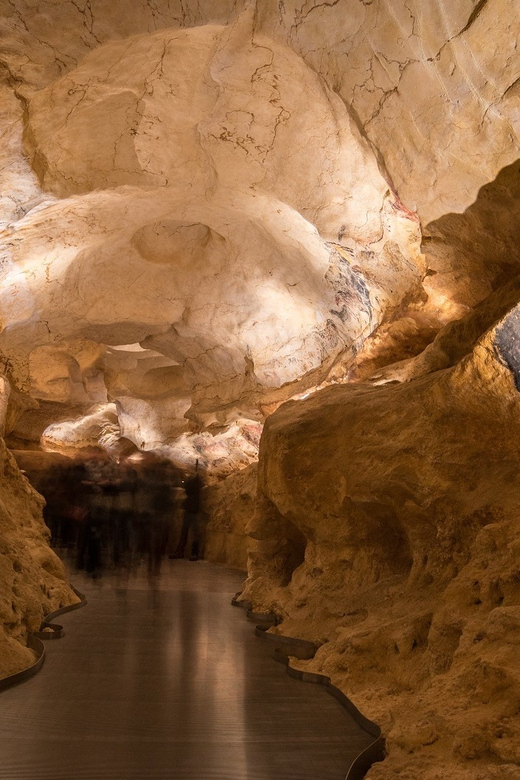
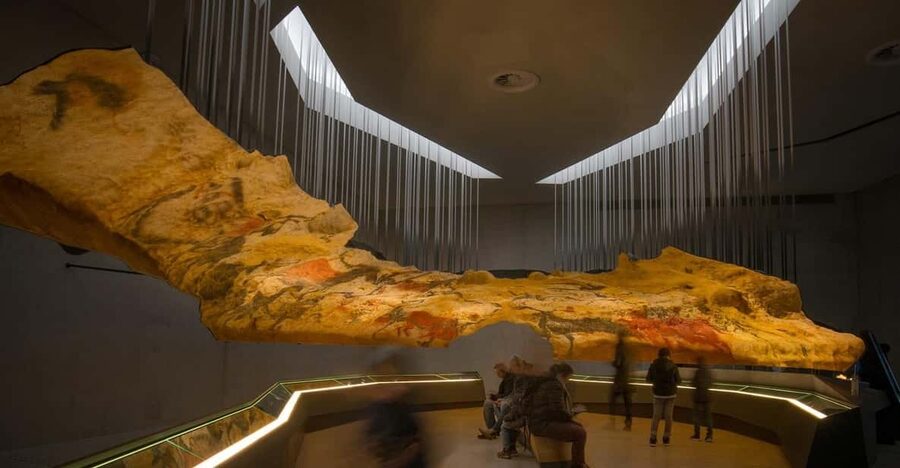
Lascaux is the headline stop. The original cave is closed to ordinary visitors because human breath, heat, and moisture can damage fragile prehistoric paintings. Lascaux IV solves that problem by recreating the cave for the public.
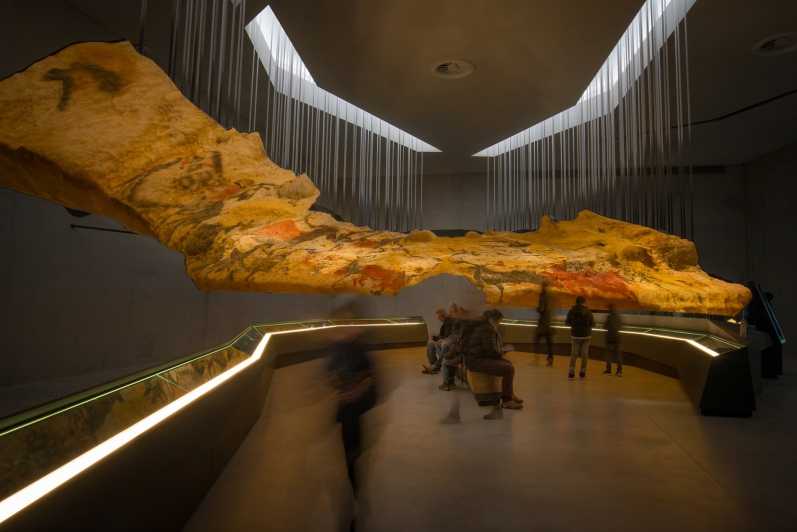
This is not a loose interpretation. The reconstruction uses a reinforced concrete shell shaped with shipbuilding methods. The contours of the original cave were copied in minute detail, and the colorful paintings were recreated using natural pigments and methods based on scientific study. The result is a full-scale presentation designed to reproduce the proportions, surfaces, and atmosphere of the original.
The building itself is part of the visit. Lascaux IV was designed as a high-tech cave complex, and the architecture helps show how a modern site can present ancient art without putting the original at risk. If you are interested in museums, conservation, or exhibition design, allow time to notice the facility rather than treating it as a simple entrance hall.
You receive skip-the-ticket-line access, a useful benefit on a tightly timed day. Lascaux entry times control the rest of the schedule, so avoiding an extra wait helps protect your time at the other sites.
The biggest caution is the language of the cave tour. English visits inside Lascaux IV are limited, and many scheduled presentations are in French. Simultaneous translation is not permitted in the cave. Your English-speaking guide explains the paintings before and after the official presentation, but you should not expect a live English translation during every minute underground.
That arrangement is manageable if you prepare for it. Listen closely to your guide before entering, note the main animals and panels you are about to see, and use the post-visit explanation to fill in gaps. The paintings remain impressive even if you do not understand every word of the formal presentation.
Expect a cool interior at about 14°C, or 57°F. A light jacket is useful even during a hot July day. Comfortable shoes are also important because the full day includes museum floors, cave facilities, outdoor paths, and stairs.
Same trip, a completely different kind of day:
- From Sarlat: Beynac & Domme Tour & Dordogne Boat Ride
★ 4.6 · 137 reviews - Au Cœur du Château – VSOP D’USSÉ & XO BARON OTARD
★ 4.5 · 108 reviews - Dordogne Day Tour : Prehistory and The Art of the Caves from Sarlat
★ 4.5 · 105 reviews - Sturgeon Fish-Farm Visit and Caviar Discovery Tasting in Neuvic
★ 4.5 · 81 reviews
La Roque Saint-Christophe and life in the cliff
La Roque Saint-Christophe is a dramatic limestone cliff that has been used as a shelter since Paleolithic times. Its troglodyte character gives the day a welcome change of scale. After spending time underground and inside museum galleries, you look up at a long cliff face shaped by erosion and human use.
The visit explains how people adapted to the rock. You learn about prehistoric shelters and later engineering built into the cliff, showing how the site continued to serve human needs long after the Paleolithic period.
This stop is not just a photo opportunity. It helps you picture why the Dordogne attracted early human settlement. The caves provided shelter, the river valleys supplied routes and resources, and the limestone created both natural spaces and workable building material.
You need to climb stairs here. La Roque Saint-Christophe is not suitable for wheelchair users and may be uncomfortable for anyone with mobility limitations. Wear shoes with good grip, and tell the company about any mobility concerns before booking.
The schedule may place La Roque before Lascaux rather than after it. Do not worry if the route feels different from the order described when you reserve. The Lascaux time slot is the controlling factor.
What the small van adds to the day
The transport is one of the tour’s practical strengths. With a maximum of eight participants, the group is small enough for direct conversation and quick movement between stops. The vehicles have been described as comfortable, and guides use a microphone so people in the back can hear explanations during the drive.
The small group also makes it easier for the guide to answer questions. Guides such as Lena and Anne have been praised for combining clear English with local stories, practical advice, and an easy sense of humor. Benoit is often singled out for his grasp of regional prehistory and his driving, while Marion and Florence have been remembered for their care and enthusiasm.
There is one seating point to consider. On a full van, you may spend the entire day in the last row. One person specifically found that frustrating because seats were not rotated. If you care about having a better view during the drives, arrive at the meeting point in good time and ask politely about seating.
The countryside between sites is part of the pleasure. You are not confined to one museum complex. The drive links villages, cliffs, wooded roads, and archaeological sites, and the guide can point out features you would likely miss while driving yourself.
Lunch, timing, and the price of $265
Meals and drinks are not included, but the schedule provides time for lunch, often around Montignac. You can expect about two and a half hours of free time there, although the order and length of stops can change according to the Lascaux booking.
This is a useful break. The day contains a lot of information, and sitting down for lunch gives you time to talk with the other members of the group and take a short walk. Guides have also been praised for suggesting places to eat.
At $265 per person, this is not a cheap sightseeing ride. The value comes from combining transport, an English-speaking driver-guide, several major sites, timed access to Lascaux IV, and a full day of interpretation. Recreating the route by car would still require planning each admission, coordinating schedules, and finding your way between places.
The price makes the most sense if you want the prehistoric sites explained rather than simply visited. It is less compelling if you already have a car, speak French comfortably, and prefer spending a long time at one museum or cave.
The tour requires at least two adults to operate. It is not available in August, and the July departure time is 8:30 a.m. rather than 9 a.m. Children under four cannot join, and you should give the child’s age when booking so an appropriate car seat can be arranged.
Free cancellation is available up to 24 hours before departure, and you can reserve without paying immediately. The activity runs in rain or shine, so plan for changing weather outside while remembering that the caves remain cool indoors.
Who will enjoy this tour most
This is a strong choice if you are staying in Sarlat and want the Dordogne’s major prehistoric sites handled in one day. It suits people interested in archaeology, early human art, geology, museum collections, and local history.
You will get the most from it if you enjoy asking questions and listening during the drives. The guide’s explanations are a major part of the value. Without them, the paintings and engravings can be beautiful but difficult to interpret.
Families with older children may also enjoy the mix of electric train, cave art, museum displays, and cliffside structures. Very young children are not allowed under age four, and the stairs at La Roque Saint-Christophe mean the day is not suitable for wheelchair users.
You should think twice if you dislike full-day tours, cool caves, stairs, or fixed schedules. The day is broken into several segments, which keeps it from feeling like nine hours of nonstop museum time, but it is still a demanding program.
Should you book this Lascaux and Rouffignac tour?
I would book it if you want the Dordogne’s prehistoric highlights in one organized day and value a guide who can connect the sites. The combination of Les Eyzies, Rouffignac, Lascaux IV, and La Roque Saint-Christophe gives you four different views of the region’s past.
Go in with realistic expectations. Lascaux IV may be presented in French, the route can change, lunch is on your own, and La Roque requires stairs. If you are comfortable with those details, the $265 price buys far more than a ride to Lascaux. It buys a carefully arranged day with expert explanation, small-group transport, and access to places that are difficult to combine on your own.
FAQ
Where does the tour begin?
The meeting point is the Place Pasteur bus stop in Sarlat-la-Canéda. The tour returns to the Sarlat area after the day’s visits.
How long does the tour last?
The tour lasts nine hours, including driving between Sarlat and the prehistoric sites.
What sites are included?
The program includes Les Eyzies and the National Prehistory Museum, Rouffignac, Lascaux IV, and La Roque Saint-Christophe. The order can change according to Lascaux IV entry times.
Is the tour conducted in English?
The driver-guide speaks English, and the activity language is English. English presentations inside Lascaux IV are limited, so the official cave visit may be in French. Your guide explains the cave before and after the presentation.
Is lunch included?
No. Meals and drinks are not included, but the schedule provides free time for lunch, generally around Montignac.
How large is the group?
The tour is limited to eight participants and uses small-group transport.
What should I bring?
Bring a passport or ID card, comfortable walking shoes, and a warm jacket. The caves are about 14°C, or 57°F.
Is the tour suitable for people with mobility issues?
No. La Roque Saint-Christophe includes stairs, and the tour is not suitable for wheelchair users. Children under four are also not permitted.
Just added around Dordogne
- Sarlat Gourmet Tour & Market Visit with Tastings★ 4.6 · 57 reviews
- Dordogne Villages Half Day Tour from Sarlat★ 4.5 · 63 reviews
- The greedy Rando quad of Nico★ 5.0 · 45 reviews
- Sarlat Gourmet Tour and Market Visit★ 5.0 · 49 reviews
- Discover Braastad Cognac★ 5.0 · 52 reviews
- From Sarlat: Beynac & Domme Tour & Dordogne Boat Ride★ 4.6 · 137 reviews
- Lascaux IV: Full Replica Cave Experience Ticket★ 4.5 · 334 reviews
- From Vitrac: Dordogne River Canoe Rental★ 4.8 · 162 reviews
Dordogne Tours, compared.

Lascaux IV: Full Replica Cave Experience Ticket
Read our review →
Au Cœur du Château – VSOP D’USSÉ & XO BARON OTARD
Read our review →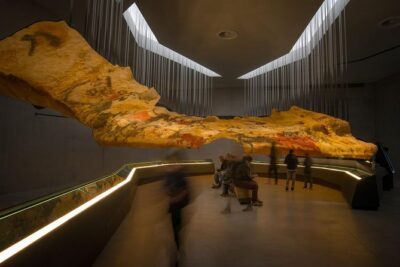
Dordogne Day Tour : Prehistory and The Art of the Caves from Sarlat
Read our review →
Sturgeon Fish-Farm Visit and Caviar Discovery Tasting in Neuvic
Read our review →
Browse the lists this tour appears in