
Reviewed · MUSéE D'ORSAY TICKETS
Paris: Best of Orsay Museum Small Group Tour with Tickets
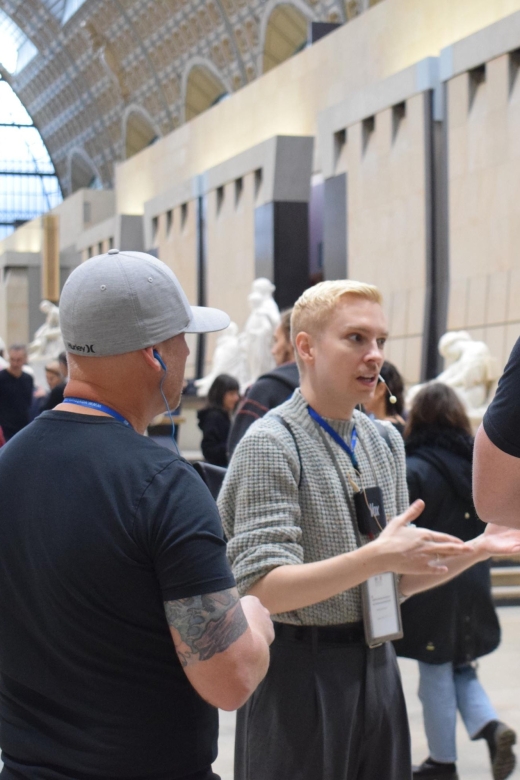
The best thing about this two-hour Musée d’Orsay tour is its clear story. You begin with the building and the academic rules that shaped 19th-century art, then follow the rebellion that led to Manet, Monet, Renoir, Degas, Van Gogh, and Cézanne. I like the small groups, often around six people or fewer, and I like that guides such as Olga, Blerta, Vanina, and Marine connect paintings to politics and daily life. The drawback is that the museum can still be crowded, warm, and noisy, especially on busy days.
I also like the practical setup: your museum ticket is included, and the meeting point is easy to find by the huge elephant statue outside. Just remember that quick access does not remove the security check, and large bags, backpacks, umbrellas, and luggage are not allowed.
Key points to know before you book

- The tour builds a story from Realism to Impressionism: Manet’s break with academic rules helps explain what Monet, Renoir, Degas, and Pissarro were trying to change.
- Groups are usually small: A group of six makes it easier to hear, ask questions, and get close to major works.
- The former railway station matters: The building is part of the experience, not just a container for paintings.
- Guides bring different strengths: Olga is praised for linking art to political and practical realities, while Vanina gives strong context about female artists such as Berthe Morisot.
- You see more than paintings: The route can include Rodin, Art Nouveau, sculpture, and an original Lady Liberty.
- Crowds remain possible: The guide can help position you near famous works, but no tour can make a packed gallery feel empty.
Why the Musée d’Orsay works so well with a guide
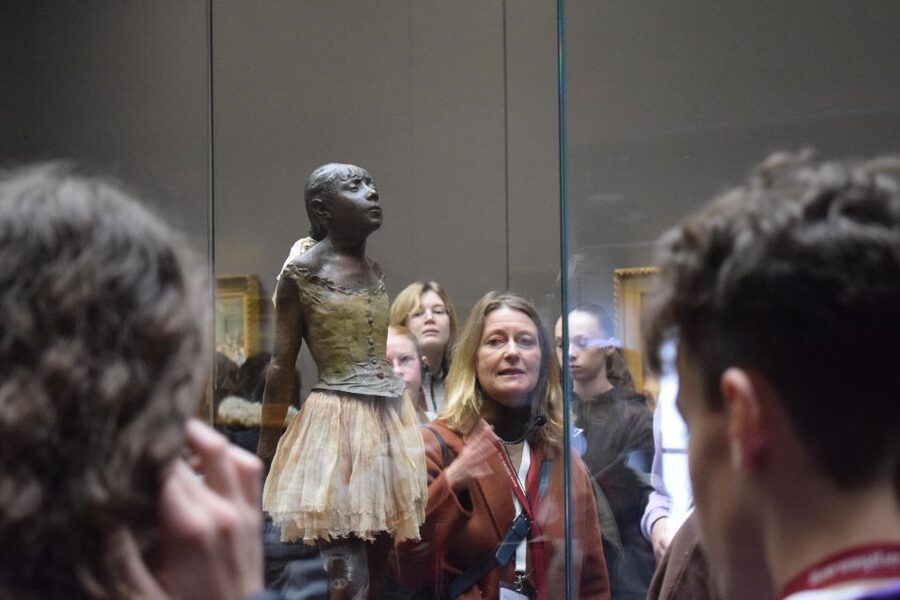
The Orsay is easier to understand than the Louvre, but it is still large enough to overwhelm you. Its collection covers the mid-19th century through the early 20th century, a period when artists changed not only how they painted, but also what subjects deserved attention.
That shift can be hard to follow if you walk from room to room without a plan. One gallery may show polished academic painting, another may present Manet’s challenge to convention, and the next may bring you to the broken brushwork of Monet or the intense color of Van Gogh. A good guide gives you the links.
This tour is especially useful if you know the famous names but not the order of events. You will hear how Realist artists such as Manet helped prepare the way for Impressionists including Monet, Renoir, Degas, and Pissarro. From there, the story moves toward Cézanne, Van Gogh, Gauguin, Matisse, Art Nouveau, and the modern art that followed.
I appreciate that the best guides do not treat the paintings as isolated masterpieces. Olga, for example, is praised for explaining the political and practical realities surrounding the artists. Vanina places Impressionism within the stricter academic system that came before it and brings attention to artists who are often left out, including Berthe Morisot.
That approach gives you something useful to carry into the rest of your Paris visit. Instead of seeing only pretty gardens, dancers, cafés, and city scenes, you begin to notice the choices behind them.
More Musee d'Orsay tickets and tours:
- Paris in a Day: Louvre or Orsay, Eiffel Tower, City Walk & Cruise
★ 5.0 · 1,956 reviews - Paris: Musée d’Orsay Entry Ticket and Seine River Cruise
★ 4.6 · 1,344 reviews - Paris: Musée d’Orsay Skip-the-Line Tour with Expert Guide
★ 4.5 · 1,145 reviews
Meeting the guide beside the elephant statue
The meeting point is in front of the museum at 1 Rue de la Légion d’Honneur, beside the large elephant statue. Look for a guide holding a Connecting France sign.
This is an important detail because the Orsay entrance area can be busy. Arrive with enough time to locate the statue and guide before the tour begins. You need a passport or photo ID, and children up to age 17 must have photo identification because the tickets are personal.
Once the group gathers, the guide usually sets the stage before moving through the galleries. That introduction may cover the building’s former life as a railway station, the development of French art, and the rules that academic painters were expected to follow.
That opening is not filler. It helps you see why the Orsay feels like a museum of artistic rebels. The building itself changed purpose, and the artists inside it changed the direction of painting.
From railway station to art museum
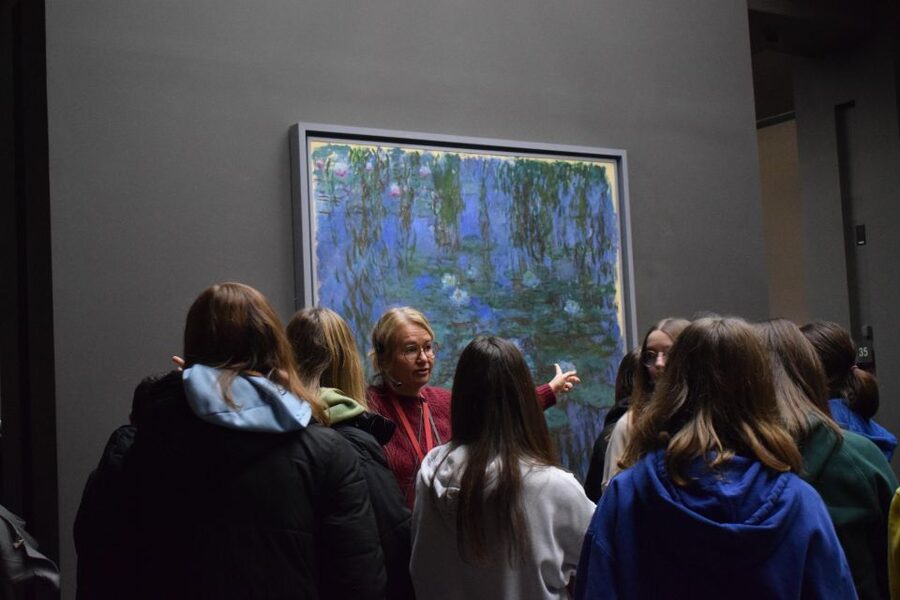
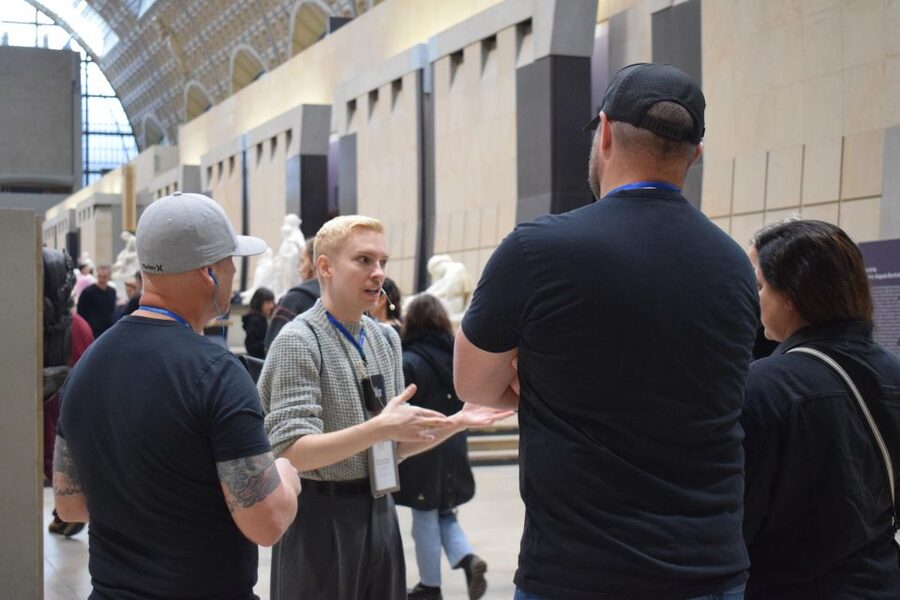
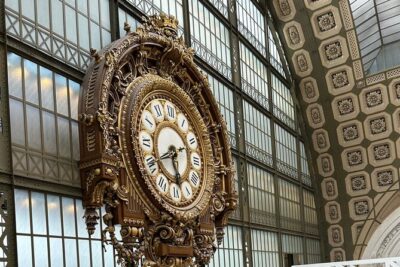
The Musée d’Orsay occupies a former railway station, and its design gives the visit a different feel from a traditional palace museum. The vast central space and visible architectural structure remind you that the building once served transportation rather than art.
Your guide points out this transformation while explaining how the museum became a home for works from the mid-19th century to the early 20th century. The building provides a useful bridge between old Paris and modern Paris: a place built for movement now holds paintings that changed how people saw the modern world.
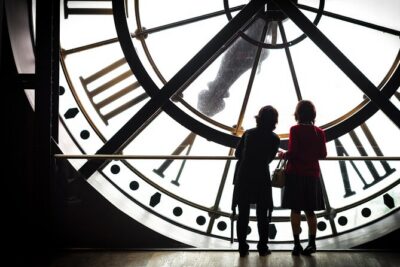
I recommend looking up as well as forward. The architecture deserves attention, and one guide, Crystall, was especially good at pointing out details of the building alongside the art. You do not need to be an architecture expert to enjoy this part. It simply gives the paintings a stronger setting.
Following the route from Manet to Monet
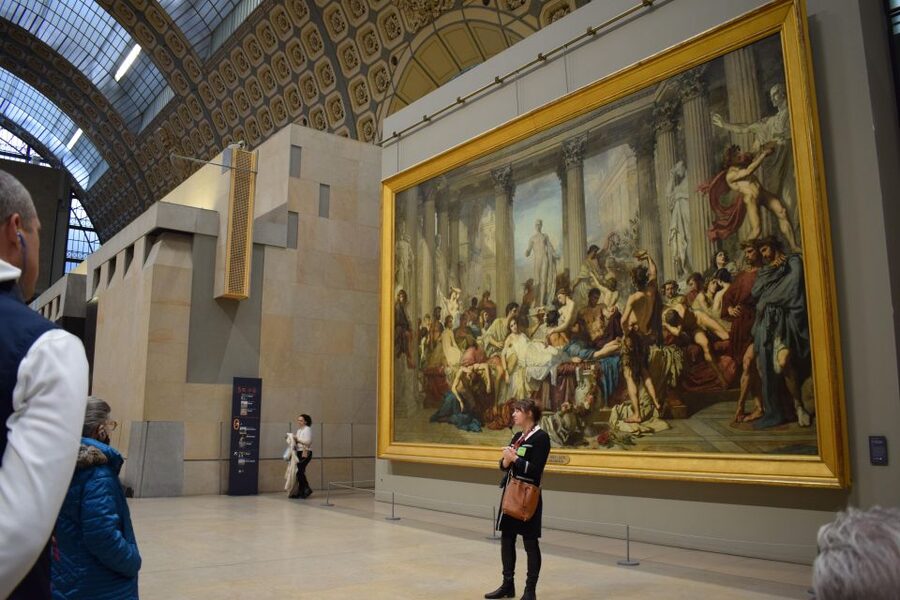
The central story of the tour is the change from academic painting to Impressionism. Academic art valued polished surfaces, accepted subjects, and strict standards. Artists who wanted to show ordinary people, modern leisure, changing light, or looser brushwork often pushed against those expectations.
Manet helps make that change understandable. He is not simply presented as another famous French painter. His work shows how an artist could challenge accepted ideas and open a path for others.
From there, the guide introduces painters such as Degas, Pissarro, Renoir, and Monet. You will learn to look at brushwork, color, light, and subject matter rather than simply asking if a picture looks realistic.
This is where a small group helps. Guides can stop beside a painting and point out a detail without losing half the group in the crowd. You can also ask why one work feels unfinished, why another uses unusual angles, or how a certain painter differed from an artistic neighbor.
The famous Dance at Le Moulin de la Galette by Renoir is one of the major stops. It gives the guide a chance to discuss modern social life, movement, light, and the way Impressionist painting can make a scene feel immediate.
You should not expect to study every important painting in the museum. Two hours is enough for a strong introduction and a well-chosen group of highlights, not a full survey of every room. That limit is useful. It keeps the visit focused, but you may want extra time afterward for rooms you pass quickly.
More museums and galleries in Paris:
- Paris: Louvre Museum Timed-Entrance Ticket
★ 4.6 · 71,977 reviews - Louvre Museum Masterpieces Guided Tour with Access
★ 4.5 · 12,023 reviews - Paris: Louvre Museum Entry Ticket With Host and River Cruise
★ 4.6 · 9,926 reviews - Les Invalides: Napoleon’s Tomb & Army Museum Entry
★ 4.6 · 9,185 reviews
Van Gogh, Cézanne, Gauguin, and the road toward modern art
The tour continues beyond the first Impressionists to artists such as Cézanne, Van Gogh, Gauguin, and Matisse. Here the story becomes less about capturing a fleeting scene and more about personal expression, structure, color, and emotional force.
Van Gogh’s work often attracts the most attention, but the guide helps place it beside other artists rather than treating it as a separate miracle. You can compare how different painters handled color, movement, and the visible marks of the brush.
Cézanne is especially important because his approach points toward later modern art. Matisse also helps show how artists could move away from direct visual description and toward stronger color and design.
The value here is not simply seeing famous names. It is understanding that these artists did not all follow one single path. The period was full of arguments, experiments, and competing ideas.
Some rooms have restrictions on speaking. Your guide will warn you when this applies. In crowded areas, sound can also be a problem. One visitor found a speaking device would have helped, while others found that the small group kept the guide easy to hear. If the museum is packed, stay close to the guide and do not drift toward the front of another group.
Sculpture, Art Nouveau, and an original Lady Liberty
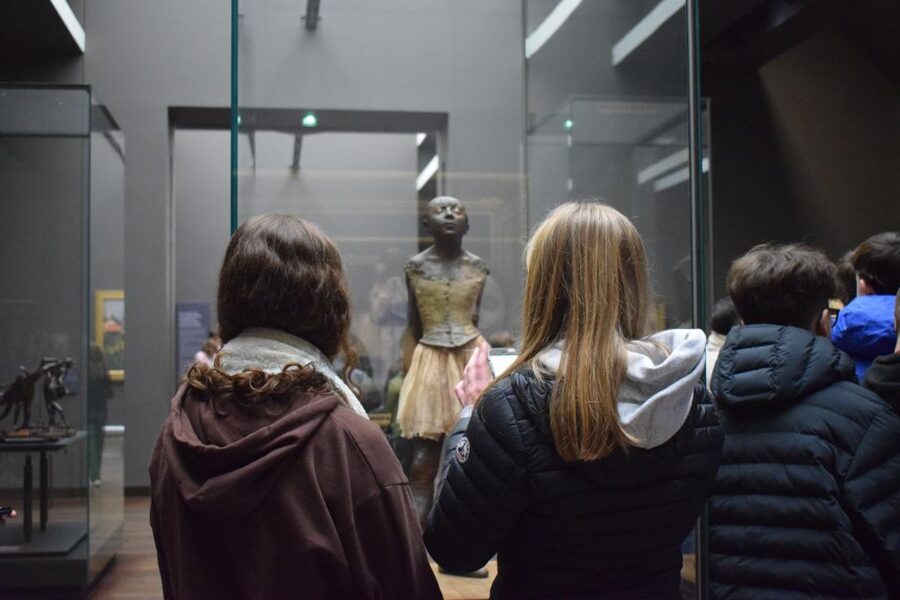
The Orsay is not only an Impressionist painting museum. The tour can also include Art Nouveau, Rodin’s sculpture, and an original Lady Liberty.
These stops broaden the story. Sculpture lets you think about form and the human body in three dimensions, while Art Nouveau shows how the period’s new ideas reached design and decoration. The Lady Liberty connection adds a surprising link to a familiar symbol.
The exact time spent on these areas depends on the guide, the crowd, and the group’s interests. If painting is your main goal, tell your guide early. If you already know the major Impressionist works, you may prefer more sculpture, architecture, or later art.
The strongest guides adjust within the limits of a shared tour. Emily, Max, and Sarah are praised for responding to group interests, while Max reportedly adapted the route when the tour became private. A private booking gives you more control, but a shared small group usually offers the better price.
What the two-hour pace feels like
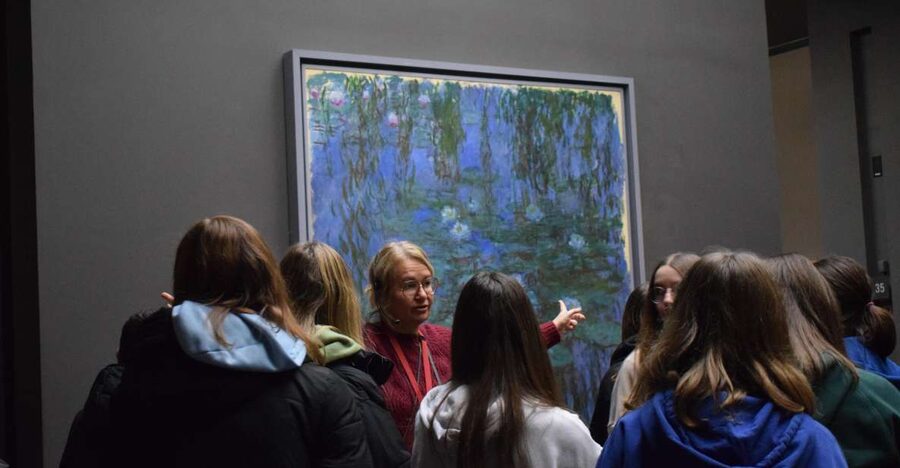
Two hours is a sensible length for the Orsay. You have enough time to understand the main artistic changes without reaching the point where every painting starts to blur together.
The pace is active. You will stand for much of the visit and move between galleries. The guide may pause for a focused explanation, then lead you to another work that adds to the story.
Several guides are praised for making the time pass quickly, but do not confuse that with a slow, leisurely museum visit. If you want long periods alone in front of a painting, plan to remain after the tour. Some groups finish with time to look around at their own pace, but you should not count on a private closing session unless your booking says so.
Crowds are the main variable. Tuesday can be particularly busy when the Louvre is closed, and holiday periods such as Easter can bring heavy foot traffic. Even on a crowded day, a guide who knows the galleries can help you reach the main works and find a better viewing position.
Is $102 a fair price?
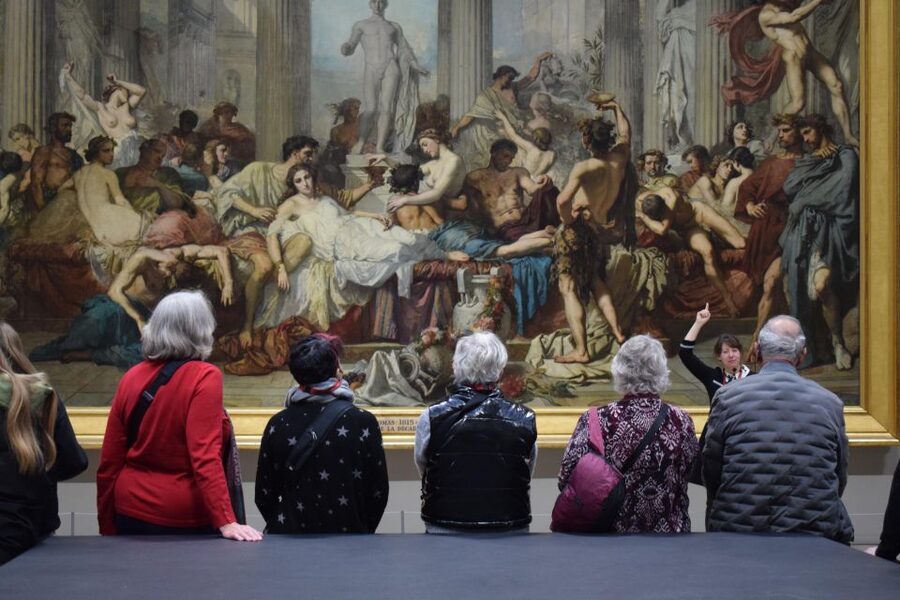
At $102 per person, this is not a bargain museum entry. You are paying for the ticket, a two-hour guided route, and the chance to see the collection with a local guide rather than navigating alone.
The value depends on your art background. If you already know the Orsay well and enjoy reading wall labels, a basic entry ticket may suit you better. You can spend the saved money on extra time inside the museum.
I think the price is easier to justify for a first visit, a short stay in Paris, or anyone who wants the museum explained in plain language. The ticket helps you avoid wasting time at the ordinary entry process, though security still cannot be skipped. The small group also matters. A group of three, four, or six lets you hear the guide and ask questions without the distance common on large coach tours.
A private option costs more in many tour settings, but it gives you better control over pace and interests. It is also the better choice if someone in your party has mobility needs, since the shared semi-private tours cannot change pace and the experience is not suitable for wheelchair users or people with mobility impairments.
Free cancellation is available up to 24 hours before the tour, and you can reserve now and pay later. Museum closures or strikes can affect the plan. In that case, the operator offers another time, a walking tour, or a refund if the alternatives do not work for you.
Who will get the most from this Orsay tour?
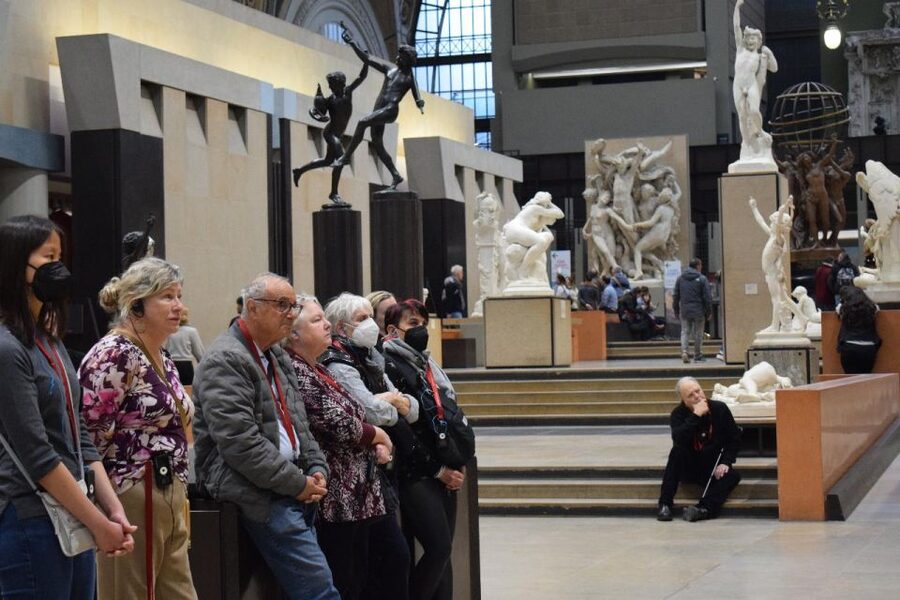
I would choose this tour for a first visit to the Musée d’Orsay, especially if you want the famous paintings but also want to understand the arguments behind them.
It suits:
- First-time museum visitors who want a clear route
- Families with older children who benefit from stories and questions
- Adults who know Monet or Van Gogh but want more context
- Short-stay visitors with only two hours for the museum
- People who prefer a small group to a large guided crowd
- Art lovers interested in social change, sculpture, and the building itself
It may not suit you if you want complete freedom to linger at every painting. It is also a poor fit for wheelchair users or anyone who needs the tour pace modified.
Guide quality is a major part of the experience. Names appearing in the guide team include Miriam, Mae, Marine, Nadia, Blerta, Olga, Helen, Mathieu, Vanina, Patrick, Antoine, Alban, Vincent, and others. The strongest feedback consistently focuses on clear explanations, enthusiasm, humor, and the ability to connect art with society. That variation means your experience depends partly on the guide assigned, but the tour format gives a strong framework.
Practical tips for getting more from the visit
Bring your passport or photo ID. Do not arrive with luggage, a backpack, large bag, or umbrella, since those items are not allowed.
Wear comfortable shoes and keep your group close in busy galleries. The museum may be warm and crowded, so a small group becomes even more useful when the space fills up.
If you have a strong preference, tell the guide near the start. You may want more Van Gogh, more Impressionism, more sculpture, or more discussion of women artists. The guide cannot rebuild the whole route, but several have shown that they can respond to the group.
After the tour, use any remaining museum time to revisit the works that caught your attention. Two hours gives you a framework. Your second look is when you can slow down and test what you learned.
Should you book this Musée d’Orsay tour?
Book it if you want a focused introduction to the Orsay, value an expert guide, and do not want to lose time finding your way through the collection. The small group format, included ticket, and strong links between art and social change make $102 reasonable for many first-time visitors.
Skip it if you prefer to wander alone, need a fully accessible pace, or already know the museum well. For everyone else, this is a practical way to see Renoir, Monet, Van Gogh, Cézanne, and the Orsay’s striking building without treating the museum as a checklist of famous paintings.
FAQ
How long does the Musée d’Orsay tour last?
The guided museum tour lasts two hours.
What is the meeting point?
Meet in front of the Musée d’Orsay at 1 Rue de la Légion d’Honneur, beside the huge elephant statue. The guide will hold a Connecting France sign.
Are museum tickets included?
Yes. Entrance tickets to the Musée d’Orsay are included.
Which languages are available?
Guides may lead the tour in English, French, Spanish, Italian, or German.
Does the ticket let me skip security?
No. The ticket provides quick access to the collections, but all visitors must still pass through the security line.
What identification should I bring?
Bring a passport or ID card. Guests up to age 17 need a photo ID because the tickets are personal.
Can I bring a backpack or large bag?
No. Luggage, large bags, backpacks, and umbrellas are not allowed.
Is the tour suitable for wheelchair users?
No. The experience is not suitable for wheelchair users or people with mobility impairments. A private tour may be booked for someone who needs a different pace, but shared semi-private tours cannot be modified in that way.
Just added around Paris
- Paris at the First Lodges – Ducasse sur Seine dinner cruise★ 4.0 · 165 reviews
- Paris at the First Lodges – Ducasse sur Seine Lunch Cruise★ 4.5 · 70 reviews
- Disneyland® Paris 1 Day with Round-Trip Train Tickets from Paris★ 4.0 · 50 reviews
- Explore speakeasies and hidden bars, sip meet & socialize★ 4.5 · 47 reviews
- Disneyland® Paris Express Shuttle with Admission Ticket from Central Paris★ 3.5 · 172 reviews
- Paris Cheeses and Wines Tour de France with Tasty Games★ 5.0 · 32 reviews
- Musée Orsay Highlights Tour – Best of Impressionism & Hidden Gems★ 5.0 · 27 reviews
- Private Tour: Discover Paris with Local, 3 hours on a Segway★ 5.0 · 71 reviews
Musée d'Orsay Tickets, compared.
Paris in a Day: Louvre or Orsay, Eiffel Tower, City Walk & Cruise
Read our review →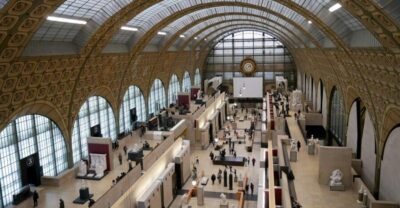
Musée d’Orsay Entry Ticket and Seine River Cruise
Read our review →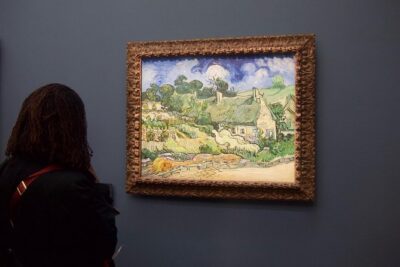
Musée d’Orsay Skip-the-Line Tour with Expert Guide
Read our review →
Musée d’Orsay Skip-the-Line Tour with Expert Guide
Read our review →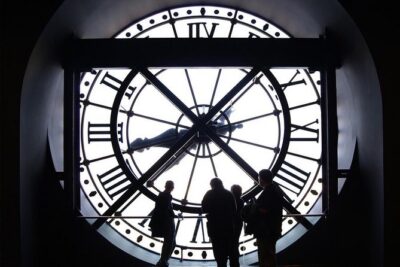
The Musée d’Orsay Guided Tour Orsay Museum Semi-Private 6ppl Max
Read our review →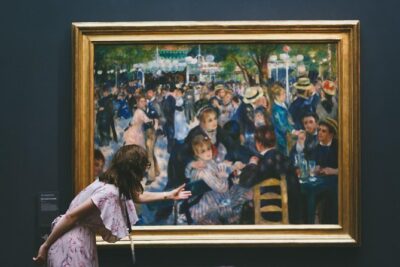
Louvre & Musée d’Orsay Guided Museum Tour Semi-Private 6ppl Max
Read our review →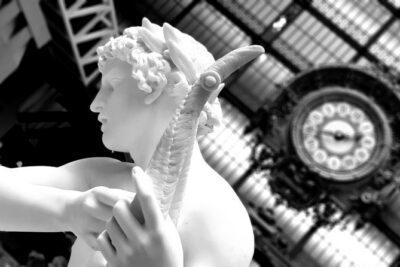
Browse the lists this tour appears in